The Flour in Your Pantry Is Lying to You — And Every Loaf You Bake Is Paying the Price
For anyone who cooks from scratch, bakes sourdough, or buys organic — and still wonders why something feels off about store-bought flour.
You're not the kind of person who grabs whatever's on the shelf. You read the labels. You pay more for organic. You switched to whole wheat years ago because you wanted to feed your family something real. And yet — somewhere in the back of your mind — there's a question you can't quite shake.
Is this actually better?
Because your bread still turns out dense. Your family still picks the white bread at grandma's house. The "whole wheat" version you worked so hard on ends up half-eaten on the counter. And you're still spending $4, $5, sometimes $6 on a bag of flour that feels — somehow — like it should be doing more.
Here's what nobody in the grocery aisle tells you: the flour you're buying, even the organic kind, even the one with the cheerful farm on the bag, is not what it was. Industrial milling strips wheat of more than 50% of its B vitamins, approximately 90% of its vitamin E, and nearly all of its fiber — that's not a blogger's opinion, that's Harvard T.H. Chan School of Public Health data. And the government's fix? They add a handful of synthetic vitamins back in. Lab-manufactured. Required by law. Not because it restores what was lost — but because the law says they have to do something.
Meanwhile, potassium bromate — a flour-processing chemical — remains legal in US flour production while it's been banned in the EU, Canada, the UK, Brazil, and China.
You've been doing everything right. The problem is the flour itself. And the solution isn't a different bag. It's a completely different way of thinking about the most basic ingredient in your kitchen.

You've Been Trying to Fix the Recipe. But the Problem Is the Flour.

There's a specific kind of frustration that builds quietly in kitchens like yours. You've done everything the blogs and cookbooks told you to do. You measure by weight, not volume. You use the good salt. You bought a stand mixer. And still — the bread isn't quite right. The texture isn't quite right. Your family eats it, but they don't ask for it again.
Most people blame themselves. "I must be doing something wrong with the hydration." "Maybe I need to proof it longer." "Maybe my oven runs hot." So they adjust. They try again. And the results improve a little — but never enough. Never the way the $9 sourdough loaf from the bakery tastes. Never the way the bread in your grandmother's kitchen smelled on Sunday mornings.
What nobody tells you — what none of the baking blogs lead with — is that the ingredient at the center of every loaf has already been compromised before it reached your counter. Commercial flour is milled months before it reaches you. It sits in warehouses. It travels through distribution. By the time you open that sealed paper bag, you are working with an ingredient that has been industrially stripped, partially reconstructed with synthetic vitamins, and oxidized through weeks of storage. Organic certification doesn't stop any of this. It just means the wheat was grown without pesticides — the milling process is the same.
"I cried! Real, unexpected tears... even after years of working as a dietitian, I had been missing something so foundational."
— Registered Dietitian, Christa Joy Ministries
That reaction — surprise, frustration, grief almost — is what this community calls the "dead flour" moment. The point where you realize the ingredient you trusted most was never what you thought it was. And once you see it, you cannot unsee it. Every loaf you bake with store flour carries a different weight. The question isn't whether to change. It's how.
You've Already Tried Everything. Here's Why None of It Worked.
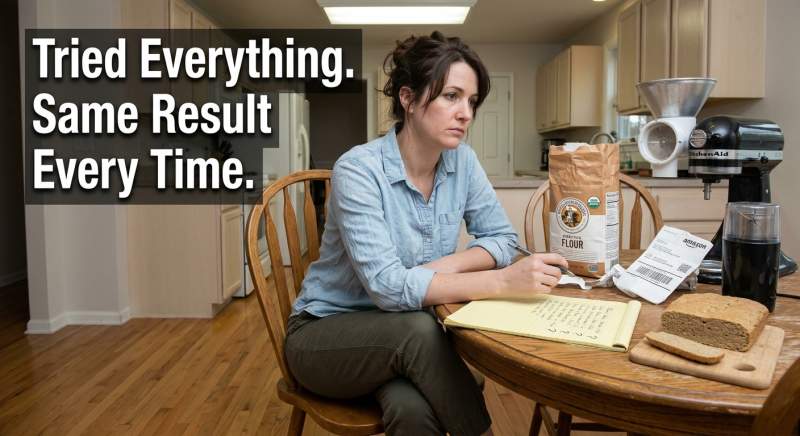
By the time someone starts researching home grain mills, they've usually already been through the entire list. They didn't start here. They started with the bag of organic whole wheat from the natural foods store. Then the KitchenAid attachment. Then the cheap grinder from Amazon. Maybe the blender. Maybe the food processor. And after all of it — they're still not where they wanted to be, and they've spent more money and more frustration than they ever expected to.
The organic flour upgrade. It makes sense on paper. Non-GMO. No synthetic pesticides. The little certified-organic seal. But here's what the seal doesn't tell you: organic certification governs how the wheat was grown, not how it was milled. The industrial stripping process — the one that removes most of the B vitamins, almost all of the vitamin E, and nearly all of the fiber — happens after the farm. Your $4.99 bag of organic whole wheat flour was still processed through industrial rollers, still had its germ and bran separated, still sat in storage while nutrients continued to degrade. You paid more and solved the wrong problem.
The KitchenAid grain mill attachment. This one feels obvious — you already own the mixer, you love the mixer, why not add a $120 attachment and have fresh flour? The reason not to comes directly from a repair professional who works on KitchenAid mixers for a living: the attachment is hard on the motor. It overheats the machine. It strains a drive system that was designed for mixing bread dough, not grinding hard wheat berries. And the flour it produces? Coarse. Inconsistent. It works until it doesn't — and "doesn't" sometimes means a $400 mixer that now runs rough. Paying $120 to damage a $400 appliance is not an upgrade.
The cheap Amazon blade grinder. One verified customer said it plainly: "I had bought a cheapish ($80) on Amazon and it broke after a month." Not two years. Not six months. A month. And even while it worked, the results were inconsistent — gritty in places, too coarse to hydrate properly, nothing like the silky, nutritious flour that the fresh-milling community talks about. The grain-mill community has a phrase for mills in this tier: "toys." Not tools. Not equipment. Toys.
The blender and the food processor. The workarounds you already own. They technically grind grain. They also overheat, leave gritty particles, create inconsistent flour, and produce results that are difficult to replicate batch to batch. They work once, maybe. They are not a system.
The premium mills. The ones the community actually recommends — the established stone burr mills, the high-end impact mills, the brands that bakers talk about online as lifetime investments. Prices start around $250 and climb past $800. Most are on backorder as of this writing. And even if they were in stock, there is a real conflict inside this audience: knowing the premium option is better but being unwilling to spend $400+ on a kitchen appliance before you even know if fresh milling is going to fit into your life. One Fresh Loaf forum member said it perfectly: "I am racking my brains out trying to choose one as there are upsides, downsides to every single one of them or they are $1,000!"
The loop closes and opens again. Nothing in the price range works. Everything that works is out of the price range. That's not a personal failure. That's a gap in the market that has been waiting to be filled.
The Turning Point: What Happens When You Grind Your Own Grain

The insight at the center of fresh milling is deceptively simple: flour is not shelf-stable the way most people assume. The moment wheat is milled — the moment the bran and germ are broken open — the oils inside the grain begin to oxidize. Nutrients that were locked inside a hard kernel for months or years are now exposed to air. The clock starts.
Commercial flour accounts for this in two ways: first, by refining the flour heavily so the germ (the most nutritionally dense and most perishable part of the kernel) is largely removed — this extends shelf life at the cost of nutritional value. Second, by using bromating agents and other processing chemicals to condition and strengthen the resulting flour. The result is a product that can sit in a warehouse for months without spoiling. What it cannot do is preserve what was there to begin with.
Fresh milling changes this entirely. You start with whole grain kernels — wheat berries, oats, quinoa, rice — which in their whole form can be stored for 25 to 30 years when properly sealed. Not months. Decades. The kernel is nature's packaging. Nothing inside degrades until you break the seal. When you grind your own flour minutes before you bake, you are working with the grain at its nutritional peak — before oxidation has taken hold, before the germ oils have turned, before any part of the kernel has had time to degrade.
Grainbloom is built around this principle. You put whole kernels in. You get fresh flour out. The 300g stainless steel grinding chamber processes grain at 25,000 RPM into flour you can use immediately — for bread, for pancakes, for pasta, for anything that calls for flour. The grain goes in whole. It comes out as flour. And everything that was in that grain — the fiber, the oils, the vitamins that industrial milling removes by design — stays in your flour.
One blogger who made the switch described it as being like "grinding your own coffee beans" — the same principle, the same logic, applied to the most basic ingredient in cooking. You wouldn't buy pre-ground coffee and let it sit for six months. You wouldn't expect it to have the same aroma, the same flavor, the same depth as freshly ground. Flour works the same way. You just weren't told.
Grainbloom also removes a specific risk that sends KitchenAid owners into the repair shop: it is a dedicated grain-milling appliance. Not an attachment. Not a workaround. Its motor is designed for this exact job. Your KitchenAid stays where it belongs — mixing dough, not grinding grain.
What Changes When You Start Milling Your Own Flour

The community has a phrase for the moment someone bakes their first loaf with fresh-milled flour: "never going back." It appears in virtually every long-form review, every blog post written by someone six months into fresh milling, every forum thread where an experienced miller answers a newcomer's question. Not because it's a marketing phrase — nobody coordinated it. It's what people say spontaneously when they describe the experience.
Here's what actually changes:
The smell changes first. Fresh-milled flour has an aroma that store flour simply does not have. Wheat berries carry oils in the germ that begin to dissipate the moment they're exposed. When you mill your own, those oils hit the air for the first time. Your kitchen smells like a bakery during the milling process — warm, wheaty, alive. People who have done it once describe going back to opening a bag of store flour as a slightly deflating experience by comparison.
The bread changes next. Not immediately — there is a learning curve, and we're going to be honest about that, which most other brands aren't. Fresh-milled flour behaves differently than store flour. It absorbs water differently. It responds differently to fermentation times. Your first loaf may not be your best loaf. But with the right starting point — and Grainbloom comes with a beginner's guide built specifically around this transition — most people find their rhythm within three or four bakes. And the difference is not subtle. It is the difference between bread that your family eats and bread that your family asks for.
The nutrition picture changes as well. Harvard T.H. Chan confirms that industrial milling removes more than 50% of B vitamins, approximately 90% of vitamin E, and nearly all fiber from wheat. Those nutrients are in the germ and bran — the parts that fresh-milled flour keeps and that industrially refined flour largely discards.
For families with grain sensitivities, the control is different in kind, not just degree. A verified account from Generation Acres Farm describes it this way: "Out of the 6 people in my immediate family, 4 of us have varying levels of gluten intolerance. All 4 of us can eat as much of these breads, muffins and rolls from the grains milled at home and we have zero issues." This is an anecdotal account — not a clinical claim. But it reflects a recurring pattern in the community: people who mill their own grain from whole, identifiable kernels know exactly what is in their flour. You put wheat berries in. Wheat comes out. There is no supply chain between your grain jar and your bread.
For those thinking about preparedness and food security, whole wheat berries stored in sealed containers remain viable for 25 to 30 years. Not months. Decades. This is a different kind of kitchen upgrade — not a luxury appliance, but a practical system. One Country Living customer wrote: "There were times I had no money for food. My friend and this mill saved my life." That's a particular kind of value that no bag of flour — however organic, however premium — can offer.
And the economics, done honestly, work in your favor. Organic wheat berries cost between $0.60 and $1.50 per pound. Organic flour at the grocery store costs $1.50 to $3.00 per pound — for a product that has already lost most of what made the grain worth buying. At two loaves a week, Grainbloom pays for itself in eight to twelve weeks. After that, you're paying less per loaf for better flour than you were paying for the bag on the shelf.
What Home Bakers Are Saying
"I now call fresh-milled flour 'alive' and store-bought flour 'dead.' And it's really true. My family noticed the difference on the very first loaf."
— Sarah M., Portland, OR
"Everything I knew about baking with white flour went out the window — in the best possible way. The aroma alone is worth it."
— Jennifer K., Boise, ID
"I wanted to jump right in and try all kinds of recipes! The beginner's guide saved me. I almost gave up after the first loaf, but now I mill every week."
— Rachel T., Nashville, TN
Here's What the Data Actually Says — Without the Inflated Claims

There's a lot of noise in this category. Competing brands inflate savings claims, fabricate review counts, and cite nutrient-loss timelines that don't exist in any peer-reviewed research. We're going to do something different: tell you exactly what the evidence shows, cite the sources, and let you decide.
On nutrient loss in commercial flour:
Harvard T.H. Chan School of Public Health confirms that industrial milling removes more than 50% of B vitamins, approximately 90% of vitamin E, and nearly all dietary fiber from wheat. This is not a fringe claim — it is one of the most well-documented facts in food science. The US government's response, mandated under 21 CFR 137.165, is to add a partial set of synthetic vitamins back into refined flour. This synthetic enrichment replaces only a fraction of what was removed and does not restore the fiber or the vitamin E. Fresh-milled whole grain flour retains the germ and bran — the parts that contain those nutrients — because you are using the entire kernel.
On potassium bromate:
Potassium bromate, a flour-processing chemical used by some US manufacturers to strengthen dough and improve rise, has been banned in the European Union, Canada, the United Kingdom, Brazil, and China. It remains legal in the United States. Not every bag of flour contains it — but you cannot tell from the label without knowing which brands use it. When you mill your own grain from whole wheat berries, the ingredient list is one item: wheat.
On the economics — with honest math:
Some brands claim you'll pay $7 per pound for store flour. Real organic flour costs $1.50 to $3.00 per pound. Organic wheat berries cost $0.60 to $1.50 per pound. The real savings from milling your own are 30% to 50% per pound — meaningful, recurring, and permanent. At two loaves per week, Grainbloom at $79.99 pays for itself in 8 to 12 weeks. Every loaf after that costs less than a comparable store-bought bag and contains more of what makes flour worth buying in the first place.
On the premium mill comparison:
The established stone burr mills recommended by the serious home-milling community — MockMill ($380–$890), NutriMill ($249–$499), KoMo ($500–$600), Country Living ($700–$767) — are genuinely excellent products designed for lifetime use. They are also largely on backorder or unavailable as of this writing. Grainbloom at $79.99 is not positioned against those products — it is positioned as the entry point for someone who wants to try fresh milling without a $400 commitment.
On the KitchenAid attachment comparison:
The KitchenAid grain mill attachment costs $100 to $150. A professional KitchenAid repair technician explicitly advises against using it because it is hard on the mixer motor. You are paying more for an attachment, risking a $300–$400 appliance, and getting coarser, less consistent flour. Grainbloom at $79.99 is a dedicated unit — less expensive than the attachment, no risk to your mixer, and a motor built for this specific job.
"Will a $79.99 Mill Actually Work — or Is It Just Another Cheap Grinder?"

We're going to name this one directly, because the home-milling community certainly will.
There is a widely held belief in grain-milling circles that any mill under $400 is essentially a toy. "All the mills costing less than $400 were more like toys," says one widely cited comparison site. This is not an irrational belief — it is the product of a lot of people who bought cheap blade grinders on Amazon and watched them break within weeks. The community has learned, through collective experience, to be skeptical of budget-tier options.
So let's be honest about what Grainbloom is and what it is not.
It is not a stone burr mill. It does not grind at low speeds the way a MockMill does. It is not designed to replace a $500 KoMo for a serious home baker who mills 10 pounds of grain a week. If that's you — if you are already committed, already baking four or five days a week, already certain that fresh milling is your lifestyle — then you should save up for the premium mill and buy it when it's back in stock. We'll say that plainly.
What Grainbloom is: a stainless steel, 300g capacity electric grain mill designed for people who want to try fresh milling without spending $400 first. Its 25,000 RPM motor processes wheat berries, oats, rice, and quinoa into flour you can use immediately. The grinding chamber is stainless steel — not plastic, not coated aluminum. The build is designed for regular home use, not for occasional weekend experiments that end in a broken lid.
And here is the thing about the "$79.99 mills are toys" generalization: it was earned by a specific kind of product — the commodity blade grinder imported and sold without any support, warranty, or accountability. A mill you can return within 30 days if it doesn't work is a fundamentally different proposition than one sold with no recourse. Grainbloom comes with a 30-day money-back guarantee. Not a "contact us and we'll see" policy. A guarantee. If you mill your first batch of wheat berries and decide this is not for you — or if the machine does not perform the way you expected — you return it. You get your money back. The risk is not yours to absorb.
The decision paralysis in this category is real. One Fresh Loaf forum member described it perfectly: "I am racking my brains out trying to choose one as there are upsides, downsides to every single one of them or they are $1,000!" Grainbloom is not asking you to make a lifetime commitment. It is asking you to try milling your own flour for thirty days. That's it. If it becomes your daily habit, wonderful — you've started. If you want to upgrade to a stone burr mill later, you'll do so knowing exactly what fresh-milled flour does for your bread, your family, and your kitchen. Either way, you'll know.
You Already Know Store Flour Is Failing Your Family. Here's How to Fix It Today.
- ✅ 300g stainless steel grinding chamber — built for wheat berries, oats, quinoa, rice, and more
- ✅ Fresh flour in under 60 seconds — from whole grain to ready-to-bake in one minute
- ✅ Dedicated grain-milling motor — grinds hard kernels without straining your KitchenAid or any other appliance
- ✅ Beginner's Fresh-Milling Guide — hydration charts, recipe conversions, and the 3 mistakes every first-time miller makes (and how to avoid them)
- ✅ Free shipping + 30-day money-back guarantee — if it doesn't work the way you expected, you return it and you pay nothing
Grainbloom is not asking you to commit to a $400 lifetime investment. It is asking you to try grinding your own flour — from whole, real grain kernels you can source, store, and trust — for thirty days. That's it. If the smell of fresh-milled grain filling your kitchen doesn't change how you think about baking, you return it. No friction. No fine print.
Thousands of home bakers have already made this shift. They are not going back to the bag on the shelf. Their families are eating bread that tastes the way bread used to taste. Their pantry holds grain that will outlast any supply chain disruption by decades. And they are paying less per loaf than they were before.
Your grain is waiting. Your loaves are waiting.
→ Get Grainbloom — Free Shipping + 30-Day Guarantee
Start with one. Gift two. Stock your pantry with three. Choose your bundle below.
Claim My Grainbloom →✓ 30-Day Money-Back Guarantee | ✓ Free Shipping | ✓ Secure Checkout