Don't Let a Bad First Loaf Be the Last Thing You Bake With Fresh-Milled Flour
For anyone who tried fresh-milled baking once, ran into trouble, and wondered whether the problem was them — it wasn't.
You did the research. You bought the grain. You followed the recipe as closely as you could. And then you opened the oven to find something dense, flat, or sticky in the middle — the kind of loaf that makes you stand at the counter for a moment, quietly rethinking the whole idea.
Maybe you haven't tried again since. Maybe you're considering fresh-milled flour for the first time and that exact scenario is the reason you've been circling back to it for months without actually committing. Either way, the feeling is the same: what if I do everything right and still end up with bread I can't eat?
That feeling is specific, and it is extremely common in fresh-milled baking. It isn't a sign that you lack skill or patience. It is a sign that fresh-milled flour behaves differently from the bag of all-purpose sitting in your pantry — and that most beginner resources either skip over that difference entirely or bury it in jargon three pages deep.
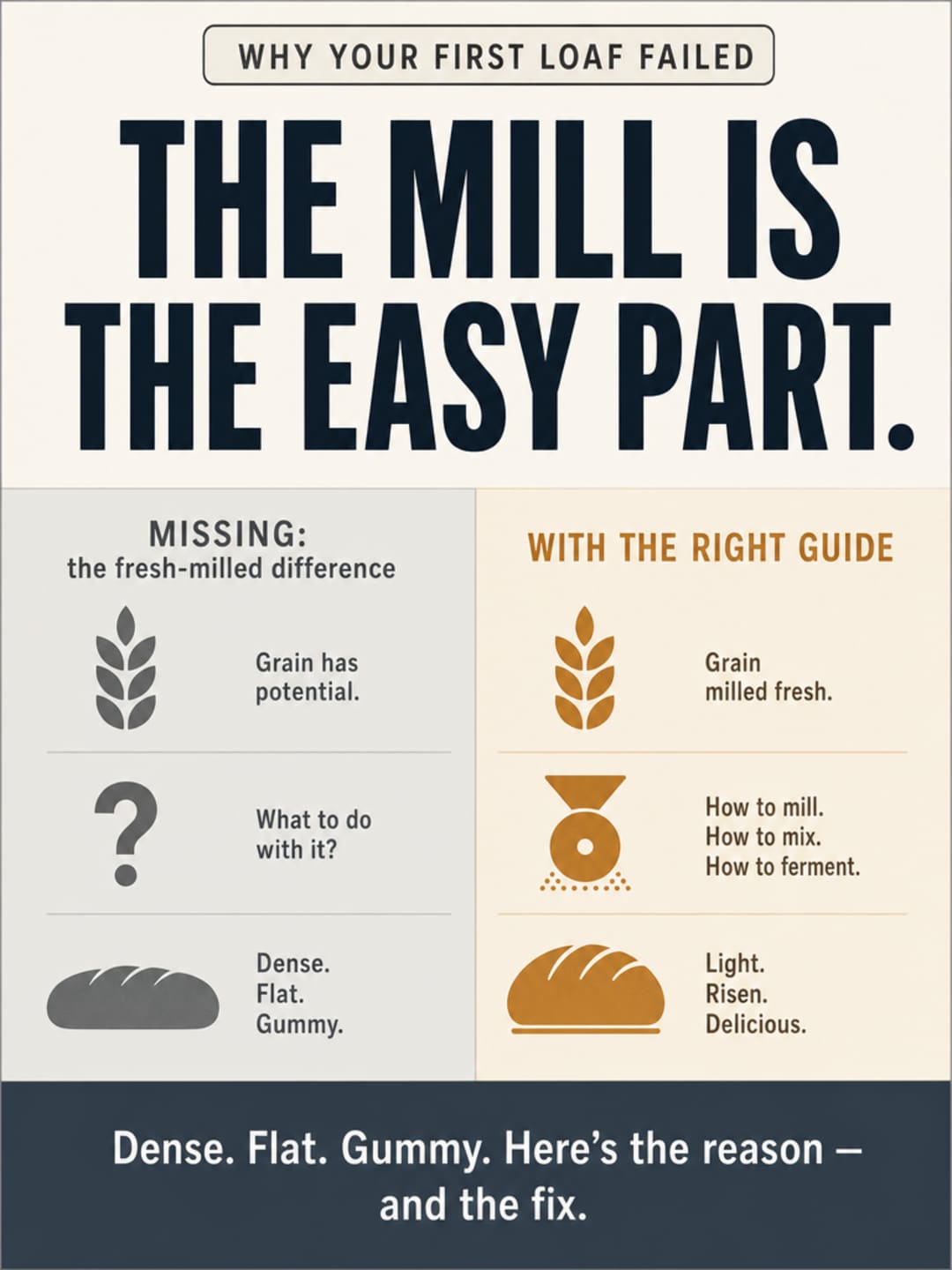
The mill is actually the easy part. Getting the first loaf right — that's where beginners either build a habit that lasts for years, or quietly put the equipment in the back of the cabinet and never touch it again. What separates those two outcomes is almost never talent. It's whether or not someone explained the fresh-milled difference before the loaf went into the oven.
The Loaf That Changed Your Mind About the Whole Thing
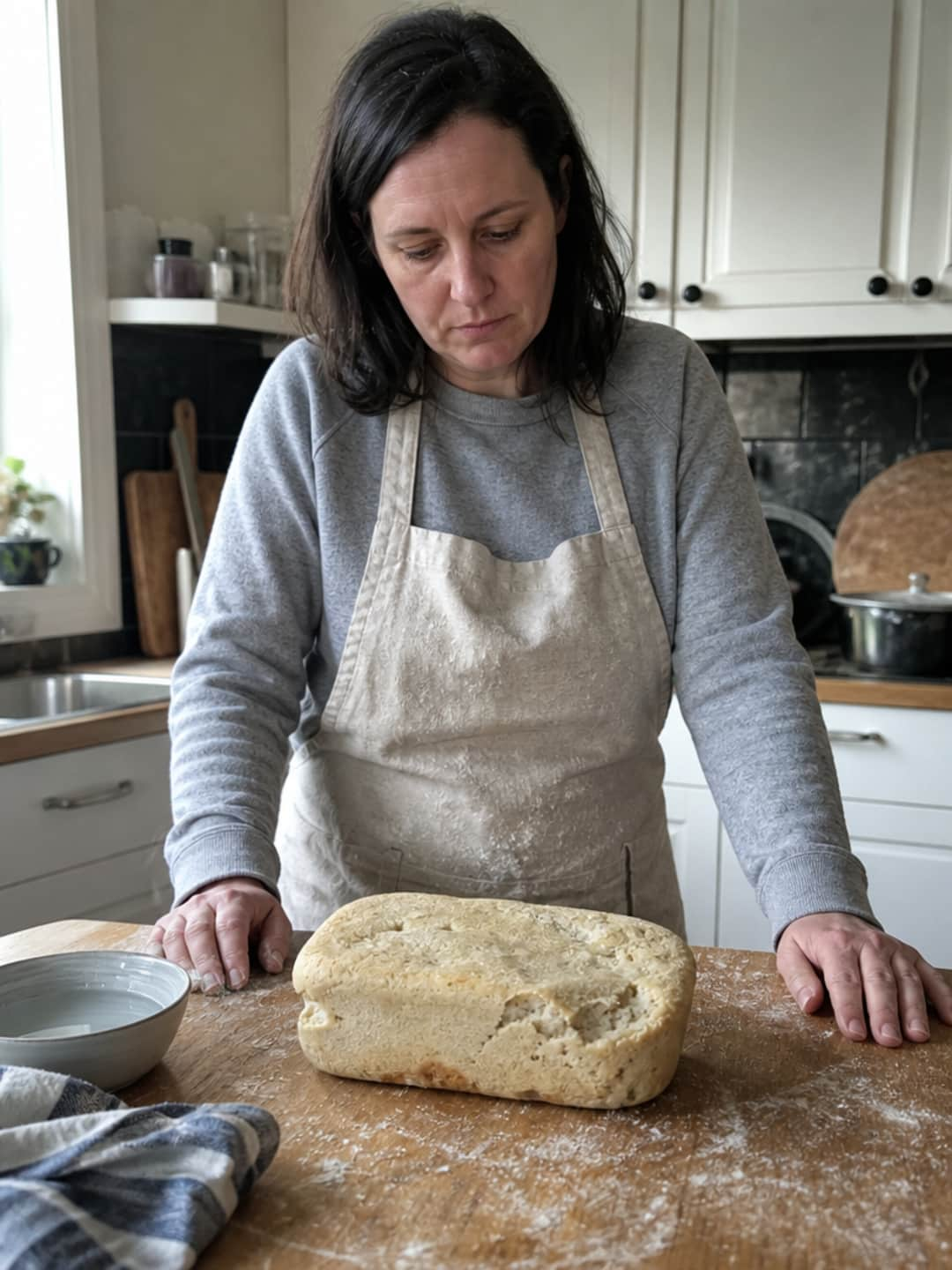
It usually happens the same way. Everything looks right going into the oven. Then the timer goes off and the loaf comes out looking nothing like what you imagined.
Dense is the most common complaint. A brick-like interior that didn't rise the way the recipe promised. Gummy is close behind — that raw-feeling, slightly wet center that no amount of extra baking time seems to fix. And flat: a loaf that spread sideways instead of climbing, with a pale, matte crust where there should have been color and crackle.
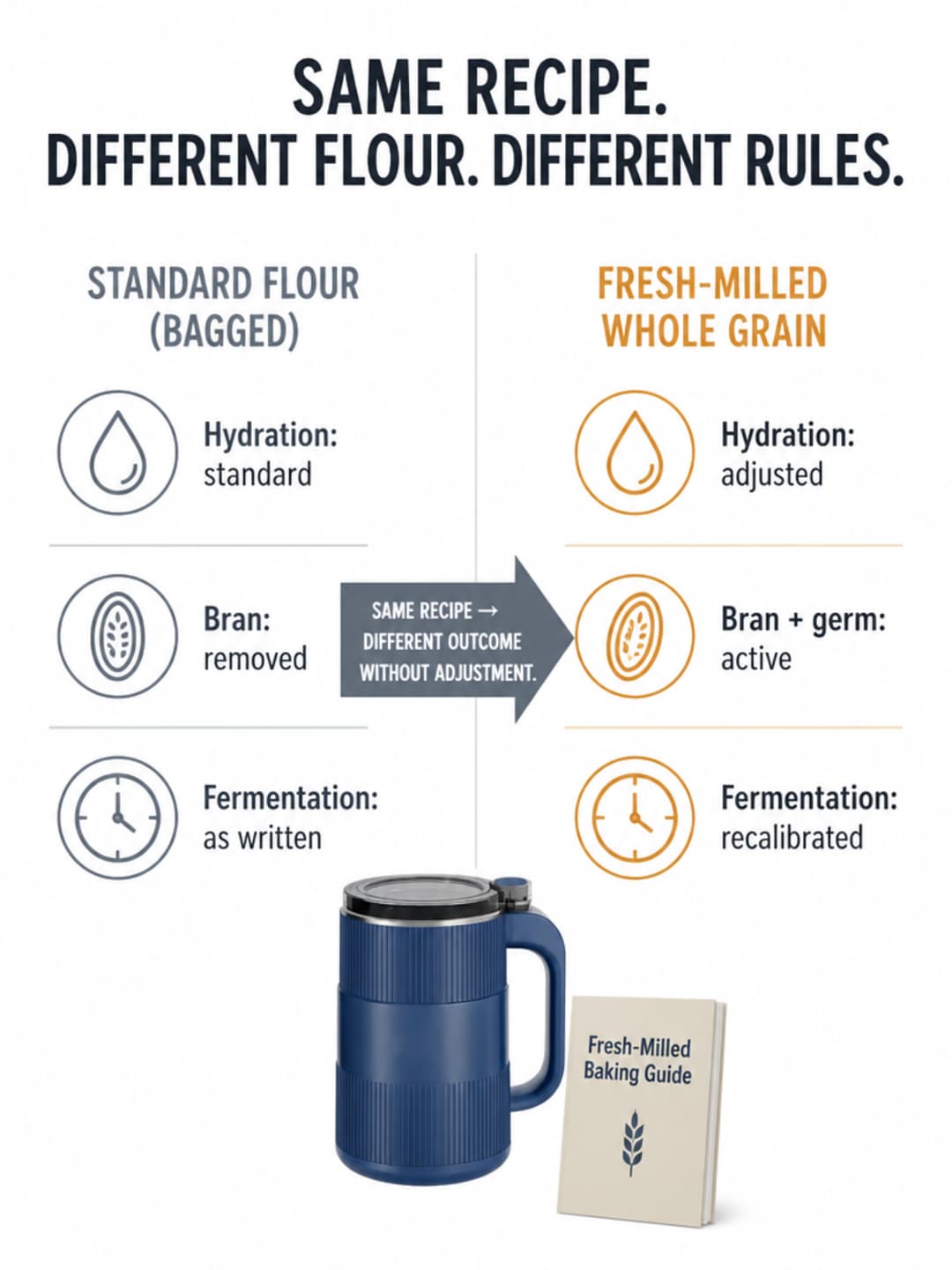
These are not random failures. They are the predictable result of applying standard wheat flour rules to fresh-milled flour without knowing the difference. Fresh-milled whole grain flour absorbs water differently than aged, sifted white flour. The bran and germ behave differently in the dough structure. Fermentation time often needs to shift. Hydration ratios that are standard for bagged flour produce a different result here. None of this is obvious from a general bread recipe. Almost none of it is labeled.
One home baker described it this way, and it captures what most beginners experience: "I did everything the recipe said and the bread was terrible. I thought I just wasn't a bread person." She wasn't wrong about what happened. She was wrong about the cause.
The gap is not skill. The gap is information that was never given.
Fresh-Milled Flour Is Not Just Fresher Flour. It's a Different Ingredient.
This is the part that most first-timers — and, honestly, most beginner bread books — skip.
Whole grain flour milled from the whole berry — bran, germ, endosperm together — absorbs liquid at a different rate than white all-purpose flour. The bran particles act like tiny sponges in the dough, pulling water away from the gluten network during hydration. The germ introduces oils that affect how the dough develops and how the final crumb sets. These are physical realities of the ingredient, not subtle flavor nuances.
What this means practically: a hydration level that produces a normal, workable dough with bagged white flour will often produce a stiff, under-hydrated dough with fresh whole wheat — or, if you compensate with extra water, an over-hydrated slack mess. Neither one rises the way the recipe predicts. Both produce the failures described above.
The same gap exists with fermentation. Fresh-milled flour contains more enzymatic activity than aged flour stored in a bag. That activity affects how quickly the dough ferments. A timing window that works for commercial yeast with bleached flour will not automatically transfer to a fresh-milled loaf. This isn't complicated once someone explains it. But nobody puts it on the front of the recipe.
The Grainbloom Fresh-Milled Baking Guide exists specifically to close this gap. It is not a general bread-baking primer. It is structured around the specific differences fresh-milled flour introduces — the hydration adjustments, the fermentation timing, the texture expectations, the common points of failure at each stage. It ships with the mill because the knowledge and the machine are part of the same system. You need both to get the first loaf right.
The Real Cost of Getting the First Loaf Wrong
There's a version of this that sounds minor: one bad loaf, a bit of wasted flour, an afternoon gone. Most people frame it that way when it happens to them.
But that framing misses what actually tends to follow.
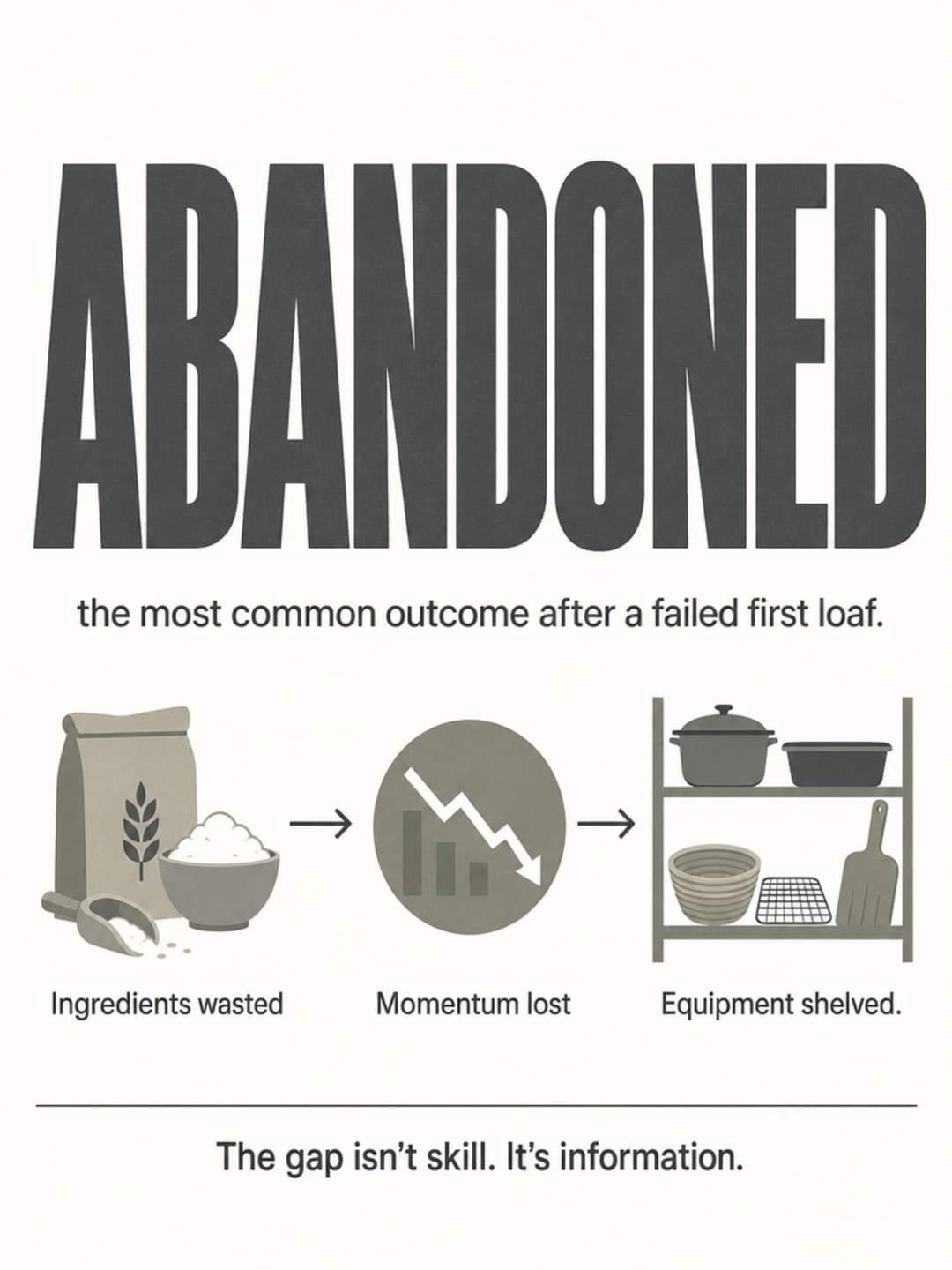
After a bad first loaf, the equipment sits. Not immediately — usually there's a second attempt, sometimes a third, each one carrying the weight of the previous failure. Then the attempts get further apart. Then they stop. The mill ends up on a shelf or in a cabinet, used occasionally and always with slightly less enthusiasm than the first time. The person who was genuinely excited about fresh-milled baking now has equipment they don't fully use and a practice they never actually established.
The cost is not the flour from one bad batch. It is the momentum that does not recover.
This pattern — equipment purchased, one difficult attempt, practice abandoned — is well-documented in the fresh-milled category. It is common enough that it functions almost as a standard arc: the excitement of research and purchase, the friction of early failure, the slow disappearance of the habit. The failure wasn't caused by lack of interest. It was caused by a specific, solvable knowledge gap arriving at the worst possible moment — right at the beginning, when the habit was most fragile.
A man of 45, close-cropped salt-and-pepper hair, wearing a dark henley described it from his own kitchen table: "I bought the grain, I bought the mill, I tried twice, and then I just stopped. It felt like too much to figure out on my own." He had the equipment. He had the motivation. He did not have the specific guidance the first few loaves actually required.
The Difference Between a Mill and a System
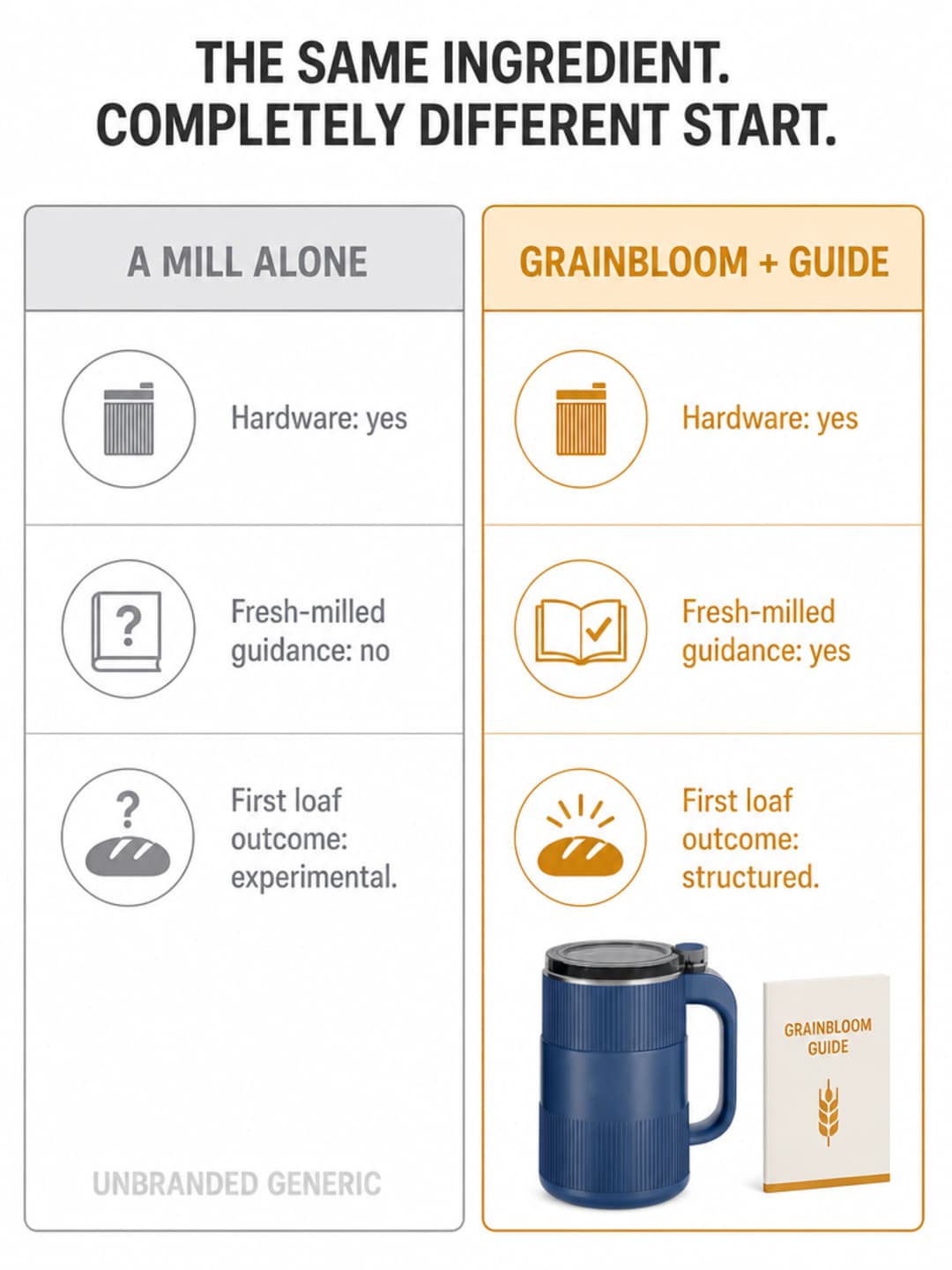
Most grain mills — regardless of price — are sold as hardware.
They tell you what the machine does. They may include recipes. They do not typically explain the specific behavioral differences that fresh-milled flour introduces into a beginner's first baking attempts. That knowledge gap is treated as the buyer's problem to solve.
The result, in practice, is that beginners hit the same wall at the same point in the process, regardless of which mill they purchased or how much they spent. The machine works correctly. The flour is genuinely fresh. The loaf still fails. Because the problem was never the machine — it was the absence of structured guidance at the critical early stage.
Grainbloom ships with the Fresh-Milled Baking Guide as part of the core package — not as an optional add-on, not as a digital PDF buried in a confirmation email. It is bundled because the two things address different parts of the same problem: the mill handles the grain, the guide handles the gap between fresh-milled flour and a successful loaf. Together they function as a system. Separately, the mill is a capable piece of hardware and the guide is useful reading — but the combination is what makes the first loaf achievable rather than experimental.
The comparison is straightforward. A mill without guidance gives you the ingredient and leaves the knowledge work to you. A mill with a structured fresh-milled guide gives you the ingredient and the framework for using it correctly from the first batch.
What the First Successful Loaf Actually Changes
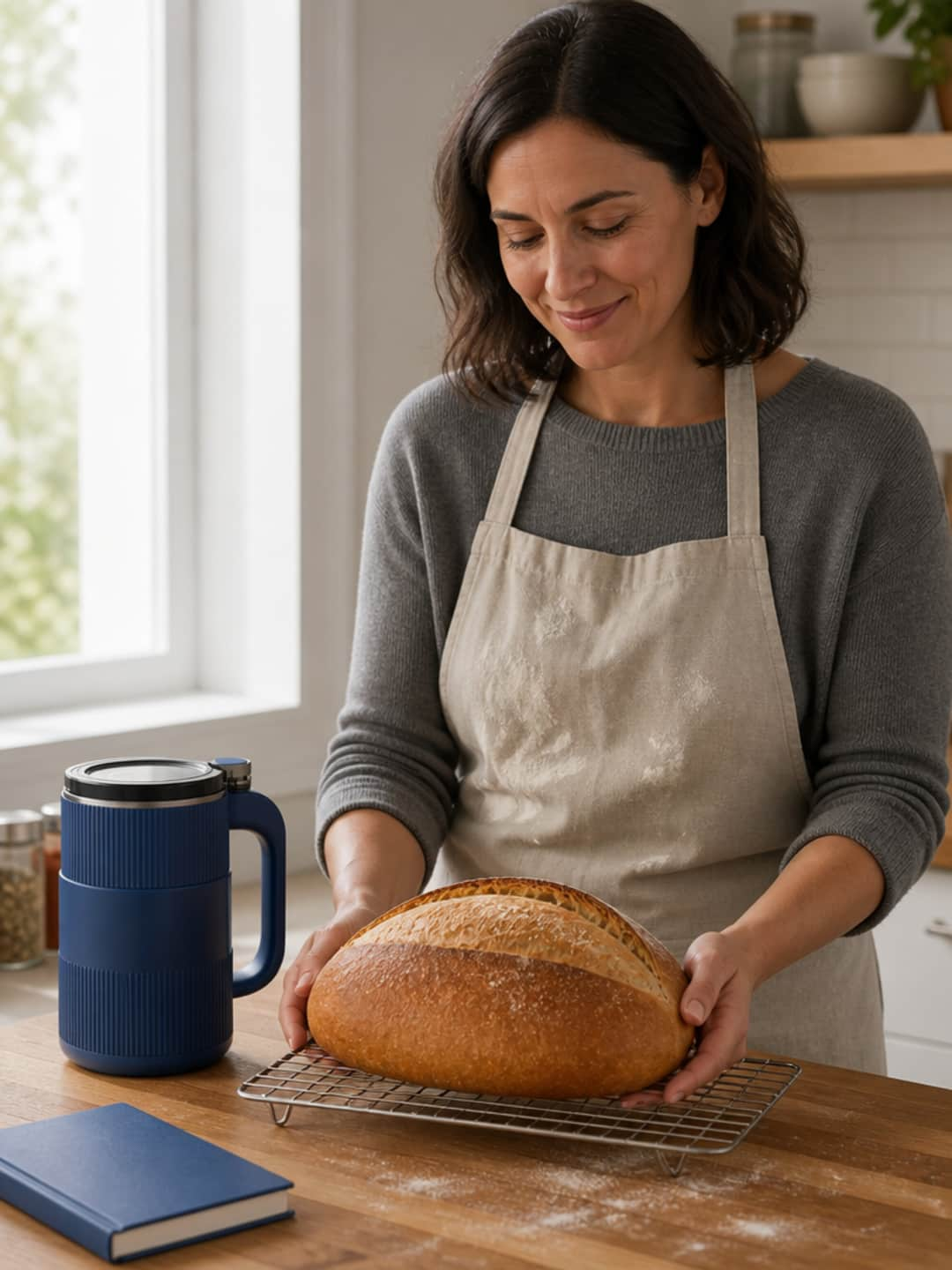
The loaf itself is not the point.
The loaf is the evidence. It is the moment the abstract promise — that you can mill whole grain at home and bake bread that tastes genuinely different from anything that comes from a bag — stops being something you read about and becomes something you can hold.
When that first loaf comes out right — risen, golden, with a crust that sounds hollow when you tap it — something settles. The concern that you might not be capable of this dissolves. Not because you proved some general competence, but because the specific thing you were afraid of — investing time and effort and ingredients into a process you couldn't control — turned out to be controllable. You adjusted the hydration correctly. You gave the dough the time it needed. The loaf rose.
From that point, the practice is self-sustaining. The habit builds. The knowledge from the guide accumulates. Each subsequent loaf is a refinement rather than an experiment. The gap between "I want to do this" and "I actually do this" closes — because the first loaf was achievable rather than discouraging.
That shift is what the combination of the mill and the guide is designed to produce. Not a single loaf, but a beginning that holds.
What Customers Are Saying
"My first attempt on my own had been a total disappointment — dense and flat. The guide that comes with Grainbloom actually explained what I'd been doing wrong. The next loaf was a completely different result."
Rachel T., Portland OR
"I'd basically given up on the whole idea after a couple of failed loaves. This combination of the mill plus the baking guide made the process feel manageable for the first time. Clear, practical, no fluff."
D. Morrison, Austin TX
"The mill itself is compact and simple to use. But honestly it was the guide that changed things — I finally understood why fresh-milled flour needs to be treated differently. Well worth it."
Margaret L., Minneapolis MN
You Can Get Back to the Loaf You Almost Gave Up On
The cost of stopping isn't the bad loaf you already made. It's the next hundred loaves you won't.
You know what went wrong. Dense, flat, gummy — those results are not a verdict on your ability. They are the predictable output of applying standard bread rules to a different ingredient without the specific adjustments that ingredient requires. Now you know what the adjustments are. The gap was never skill. It was information. And that's a solvable problem.
Here's what changes when the first loaf works:
- The failure cycle ends. The dense-loaf-discouragement-equipment-sits pattern doesn't start if the first attempt is genuinely guided.
- The habit forms where it used to collapse. Beginners who get early wins keep baking. Beginners who get early failures mostly don't.
- The guide closes the specific gap. Not general bread knowledge — the fresh-milled-specific adjustments for hydration, fermentation timing, and texture that standard recipes don't include.
- The mill handles the grain. One button, a compact countertop footprint, fresh flour ready to use. The machine is the easy part — and it should stay the easy part.
- The system is designed to produce a successful first loaf, not just a fresh-milled ingredient.
Every day you wait, there's a version of you who still hasn't tried again — who still has the idea filed away under "something I keep meaning to revisit." That version doesn't get the loaves. The habit never calcifies. The equipment either doesn't get bought or doesn't get used.
The information that would have made the first loaf work is now in one place, bundled with the mill that produces the flour. You don't have to reverse-engineer the difference between fresh-milled and stored flour from conflicting recipe comments online. Someone already did that work.