That Bag of Flour on Your Counter Has Been Sitting There Longer Than You Think
You bought the flour recently. The bag is clean, the seal was intact, and the brand is one you've used for years. Nothing about it looked wrong.
But flour isn't made the day you buy it. It isn't even made the week you buy it. By the time whole grain is milled at an industrial facility, bagged, shipped to a regional distributor, palletized to a warehouse, trucked to a retailer and finally shelved until you pick it up — months have passed. Sometimes considerably more than that. You have no way of knowing, because the bag doesn't tell you.
This isn't a fringe concern. It's just how the supply chain works, and almost nobody in it has any reason to advertise it to you.
The strange part is that most home bakers already know, at some level, that fresh ingredients perform better. Fresh yeast versus old yeast. Fresh spices versus the dusty jar in the back of the cabinet. Freshly ground coffee versus the pre-ground bag that's been open on the shelf for two weeks. Everyone who has made that comparison once knows it isn't subtle. The flour question is the same comparison — it just hasn't become common knowledge yet.
What changes when you mill flour right before you use it, from whole grain you store yourself, is not a marginal improvement. It's a different starting point entirely.

You've Never Seen a "Milled On" Date, and That Isn't an Accident
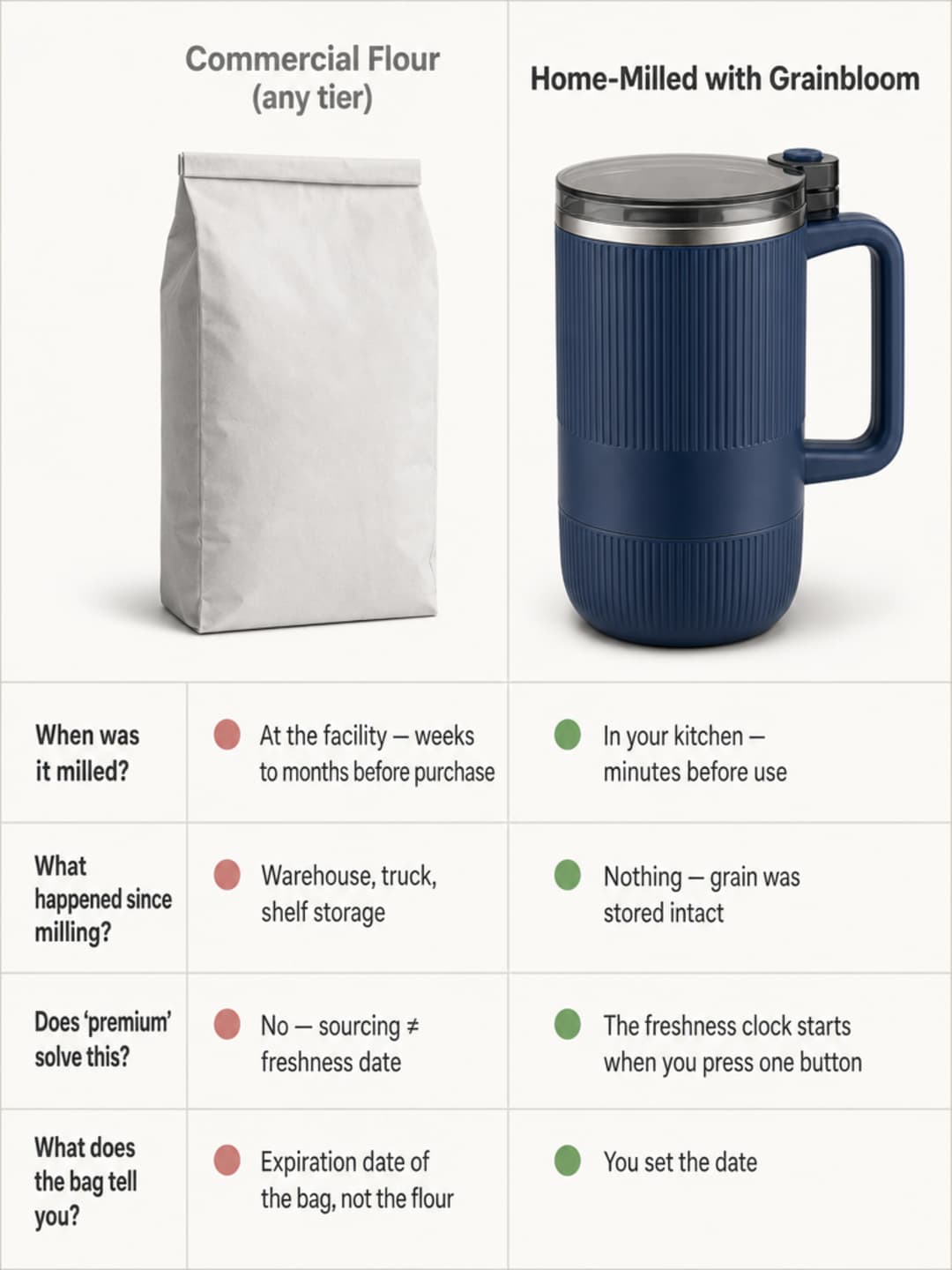
There is a date stamped on every bag of flour. It tells you when the bag should leave a store shelf. It tells you nothing about when the grain inside it was processed.
That distinction matters more than it sounds. Flour is a biological product — whole grain contains oils, bran, germ, the full set of components the plant developed to sustain its seed. From the moment those components are exposed by milling, they begin to change. The oils are no longer protected by the intact grain structure. The bran is open to air. The germ — the part with the most going on nutritionally and aromatically — is now a cut surface in a bag.
Industrial flour is designed to extend shelf life. Part of that involves removing the germ entirely in white flour, because germ oil turns. Part of it involves storage conditions designed to slow the clock. None of that stops it. It slows it.
When bakers describe commercial flour as smelling "papery" or "flat," they're not being precious. They're accurately describing what happens when flour has been stored for a long time without those protective grain coats intact. It's the same phenomenon as old nuts going rancid, or coffee going stale after grinding. The product is chemically different from what it was when it was fresh, and it behaves differently.
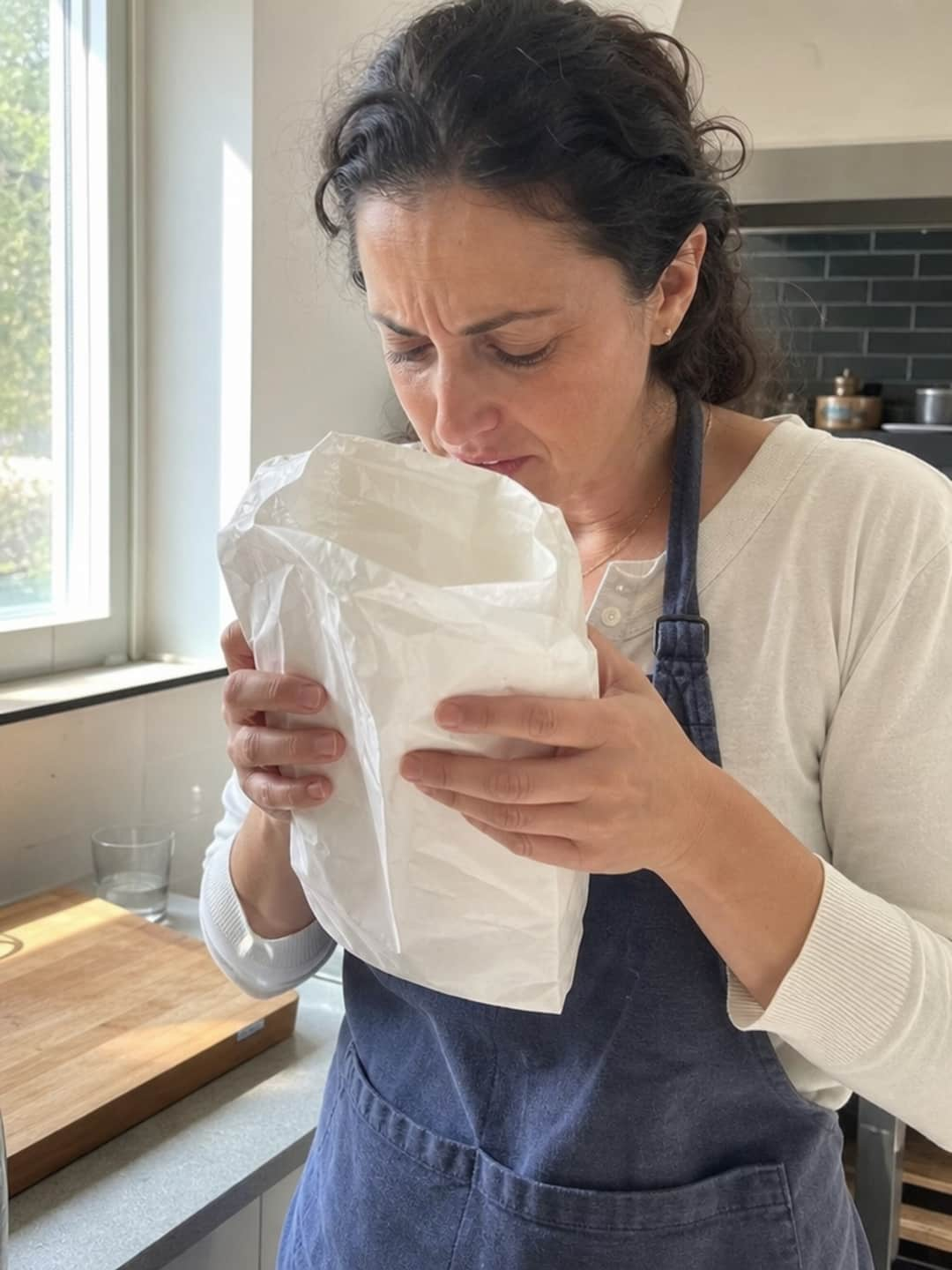
Maya — a woman of 38, dark wavy hair pulled back loosely, wearing a faded navy apron over a cream henley — opened a new bag a few weeks back and took a smell before she used it. She assumed what most people assume: that anything sealed must be fine. The smell wasn't bad, exactly. It just wasn't much of anything. She used it anyway.
What she didn't know, and what very few home bakers think to ask, is whether there's another way.
And here is where it gets practical: the clock doesn't start when you open the bag. It started when the grain was milled, wherever the facility was, however many months before the bag reached you.
What Happens to Flour Between the Mill and Your Hands (The Part Nobody Mentions)
The mechanism is worth understanding plainly, because once you see it, the "just buy a bag" habit becomes hard to unsee.
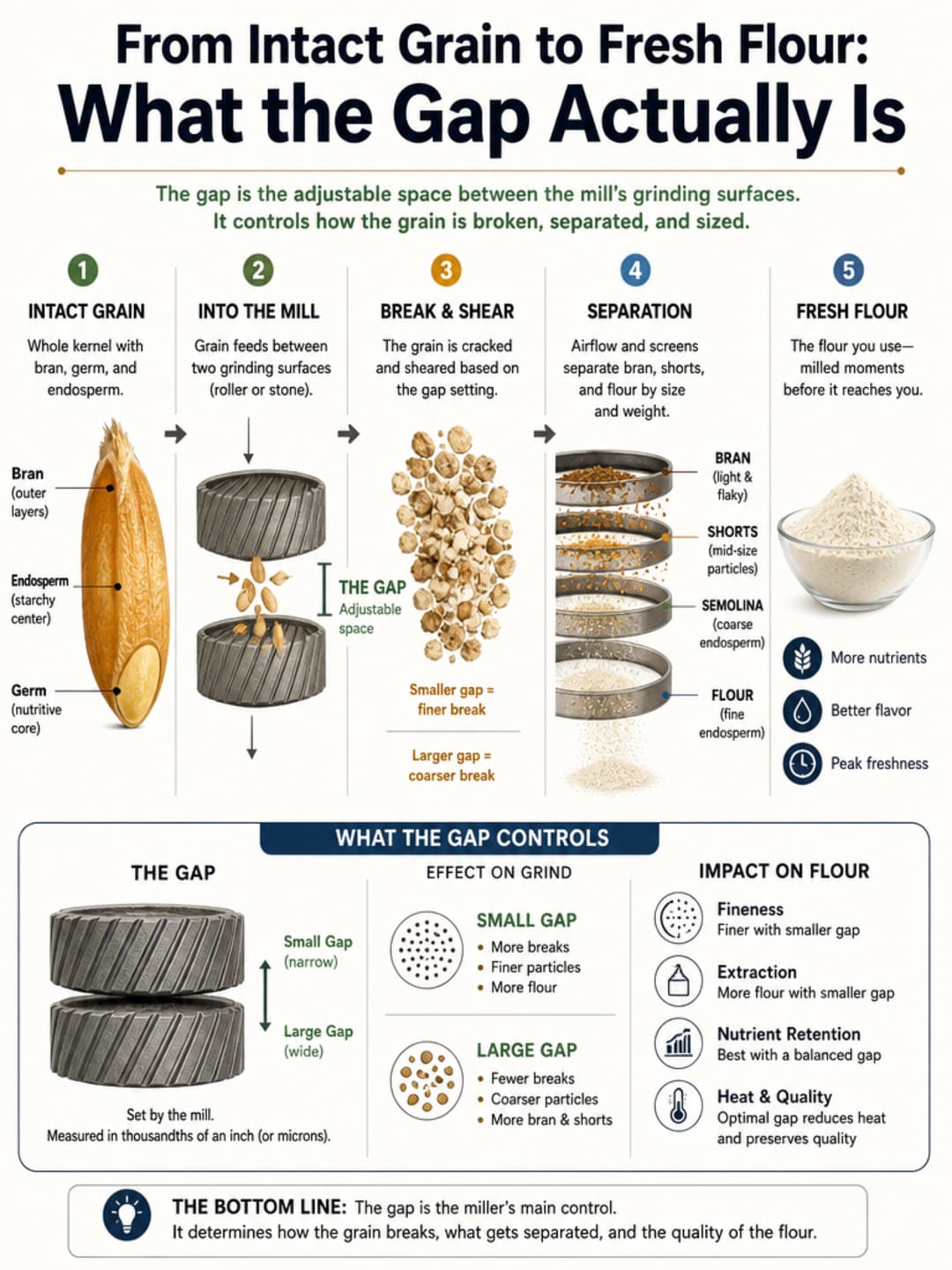
Whole grain — wheat berries, for instance — is a sealed system. The outer bran layer acts as a physical barrier. The germ is tucked inside. The starchy endosperm (which becomes your flour) is protected from oxygen, humidity and light as long as the grain remains intact. Whole berries can be stored for months or years in reasonable conditions without meaningful degradation, because the plant engineered them to survive until conditions were right for germination.
The moment milling happens, that sealed system opens. Bran separates from germ from endosperm. Surfaces that were never exposed are now exposed. The oils in the germ — present in whole wheat flour — are now in contact with air. Time starts running.
Commercial mills process enormous volumes. The flour is then bagged, palletized, shipped and distributed through a supply chain with multiple holding points. The flour that reaches your pantry shelf is the same flour that left the mill weeks or months earlier. The bag it's in is a better storage vessel than leaving it open, but it is not airtight in the way an intact grain is airtight, and it does not stop the clock — it slows it.
Home milling reverses this completely. You store the whole, unbroken grain — which is genuinely stable — and mill only what you need, immediately before you use it. There is no warehouse leg. There is no distribution lag. There is no palletized holding. The gap between milling and mixing is measured in minutes, not months.
Grainbloom's mechanism is straightforward: whole grain berries go in the hopper, you press one button, and approximately 60 seconds later you have a fresh batch — roughly 300 grams — ready to go directly into whatever you're making. The stainless steel internal components contact the grain briefly and only during that minute. You are not investing in a complex production process. You are closing the gap between the mill and your mixing bowl.
Most Bakers Have Already Noticed — They Just Didn't Know What They Were Noticing
This is about what the stored-flour problem actually costs in concrete baking terms — not in abstract nutritional language, but in the results that show up in the finished loaf.
Flour that has been milled and stored loses aromatic complexity over time. The volatile compounds responsible for the smell of fresh bread begin degrading before you ever mix the dough. The germ oil, present in whole wheat flour, turns — sometimes mildly, sometimes enough to add a faintly bitter undertone to the finished loaf. The baking performance of flour changes with age too: gluten development can be affected by the state of the proteins in the flour, and while freshly milled flour behaves differently from aged flour in ways that take some adjustment, experienced bakers who have worked with both describe the difference as significant.
Daniel — a man of 45, close-cropped salt-and-pepper hair, wearing a grey fleece pullover over a dark plaid shirt — spent almost two years troubleshooting inconsistent loaves before he started asking questions about flour age. He had assumed the variable was his technique, or his oven, or his starter. He had bought progressively more expensive flour on the assumption that quality would solve it. Some of it helped marginally. None of it solved the fundamental issue, which was that he was working with a product milled months before it reached him, and he had no way to know how long ago or under what conditions.
The bakers who describe the shift to fresh-milled flour consistently use the same language: richer aroma while mixing, more complex flavor in the finished loaf, a nuttiness that commercial flour doesn't have. That language is consistent enough across independent accounts that it's worth taking seriously as a category observation, not just enthusiasm.
The number that deserves to sit in the front of your mind here is this: there is no regulatory requirement to tell you when flour was milled. You are buying a product with an expiration date that tells you about the bag's shelf life, not about the flour's freshness at the moment it was processed. The gap between those two things is the entire problem.

What "Premium Flour" Actually Gets You (And What It Doesn't)
There is real variation between commercial flours — stone-ground versus roller-milled, high-extraction versus refined, organic versus conventional. These distinctions matter at the margin. A high-quality stone-ground whole wheat flour will generally perform better than a commodity product.
But none of those distinctions address the fundamental supply chain gap. A flour can be organic, stone-ground, sourced from a single heritage grain variety, and still have been milled three months before you opened the bag. Certification and sourcing tell you about what the grain was. They don't tell you when the flour was made or how long it has been sitting.
Renata — a woman of 52, silver-streaked hair worn straight to her shoulders, wearing a loose linen shirt over a white tank — has been buying the same organic stone-ground whole wheat flour for years. She pays meaningfully more for it than she would for commodity flour. She has assumed that "organic" implies fresh, or at least fresher. It implies nothing of the sort.
The comparison that matters is not premium commercial flour against budget commercial flour. It is any commercial flour — at any price — against flour milled at home, immediately before use.
On one side: a product whose freshness clock started at the industrial mill, somewhere in the supply chain, before it reached your store. On the other side: flour whose freshness clock starts in your kitchen, when you need it, from whole grain that was stored intact.
The extra cost of the premium bag buys you better raw material going in. It does not stop time.
The Shift Is Smaller Than You Think
The realistic version of this matters: milling flour at home is not a production commitment, and it does not require learning a new discipline.
The friction that keeps most people from trying it is the assumption that this is a substantial addition to the baking process. Another appliance to set up. A complicated step. Something that has to be figured out before it becomes useful.
Grainbloom's design addresses this directly. One button. Approximately 60 seconds for a batch of around 300 grams — enough for a standard loaf. The hopper opens from the top, grain goes in, flour comes out below. The footprint is countertop-sized; it doesn't require dedicated storage or reorganization. You mill what you need, when you need it, and you are back in the baking process within a minute.
The difference between the person who mills once and abandons it and the person who does it as a natural part of their baking routine is almost entirely about friction. If the process takes five minutes of setup and another twenty of operation, it becomes a project. If it takes sixty seconds between measuring your grain and having flour in your bowl, it becomes a habit.
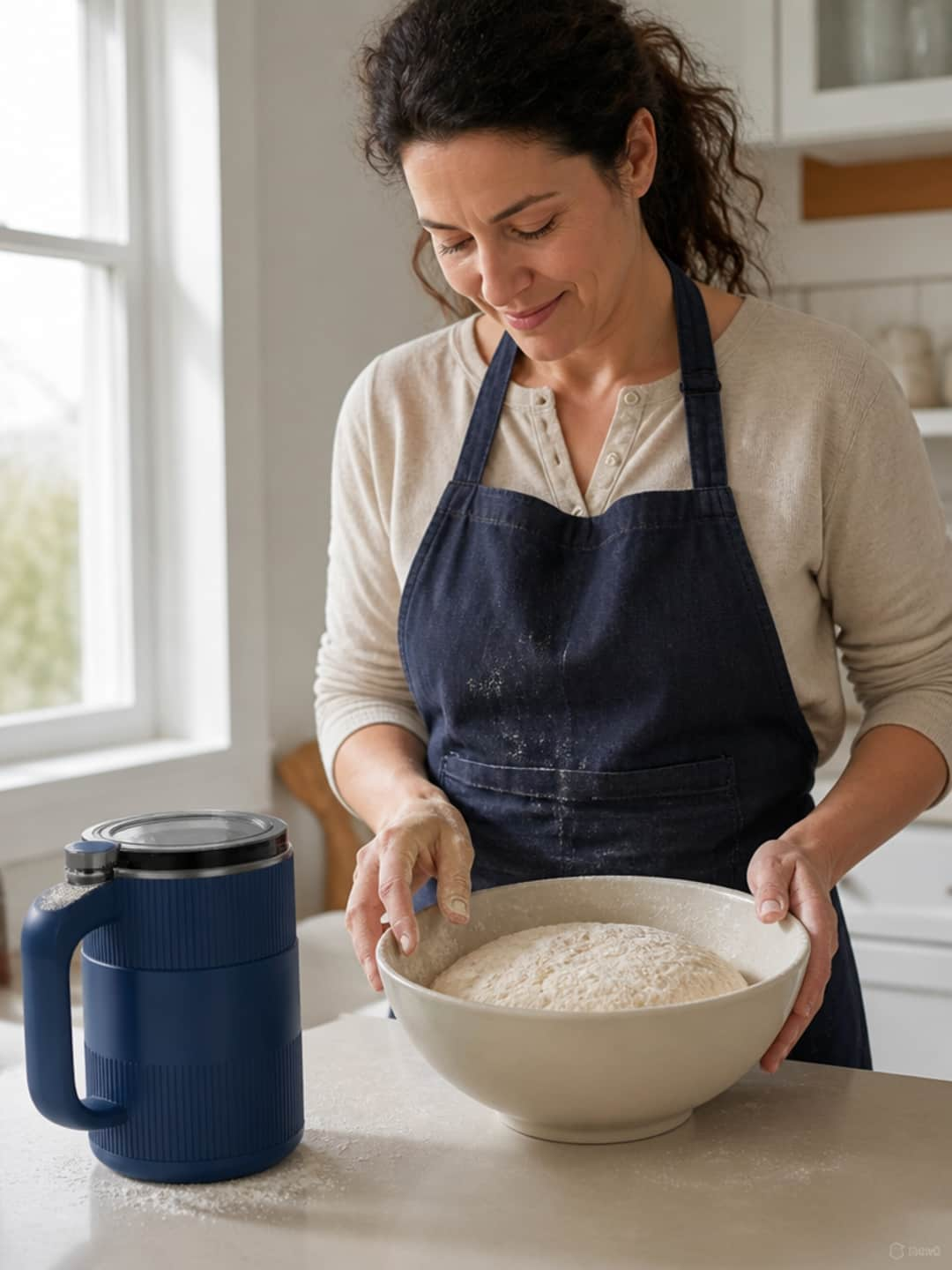
Maya — a woman of 38, dark wavy hair pulled back loosely, wearing a faded navy apron over a cream henley — runs through the same Friday evening baking routine she's had for years. The thing that changed is where the flour comes from. She stores wheat berries in the same cabinet where she used to keep the bag. She presses one button while her oven preheats. By the time she has her other ingredients measured out, the flour is in the bowl.
The loaf smells different while it's mixing. It tastes different when it's done. She couldn't unsee the mechanism once she understood it — and she can't unsmell the difference now.
Everything you were already doing stays the same. The flour just starts fresh.
What Customers Are Saying
"I genuinely could not believe the difference in smell when I mixed my first batch of dough with fresh-milled flour. It's the kind of thing you notice immediately and then can't ignore. Simple to use, quick to clean up."
— Sarah K., Portland OR
"I spent two years blaming my technique for inconsistent loaves. Switched to milling my own flour and the first loaf using fresh grain was noticeably different — more flavor, better aroma. Does exactly what it says."
— M. Reyes, Austin TX
"Compact, practical, and genuinely fast. I was skeptical it would become a regular habit but pressing one button for 60 seconds is easier than any other part of my baking routine. Well made and worth it."
— Christine L., Chicago IL
You Cannot Unbuy the Flour You Already Have. You Can Change Where the Next Bag Comes From.
The thing that most home bakers who discover this feel is not anger about the past — it is a quiet, specific annoyance that nobody told them the question was worth asking.
You have been buying flour assuming that "fresh" was determined by when you bought it. The bag was new. The seal was intact. The brand was one you trusted. None of that tells you when the flour inside was actually milled, or how many transfer points it passed through before it reached your kitchen, or what happened to those exposed grain oils in the meantime.
That is not a reason to feel misled. It is a reason to consider a different starting point.
The mechanism is simple. Whole grain stores intact and stable. You mill what you need, when you need it. The gap between milling and mixing — the gap that the commercial supply chain stretches to weeks or months — collapses to minutes. The flour that goes into your dough is flour that didn't exist until this baking session.
What that changes in the loaf is something you will notice the first time you use it. Not a dramatic reinvention — the same recipe, the same technique, the same oven. But the smell while mixing is different. The flavor in the finished bread is more present. Bakers who make the switch describe it consistently, and the consistency is the tell.
The choice to keep buying commercial flour isn't wrong. It's just the default. And now you know what the default costs — in months between milling and your bowl, in aromatic loss before you ever open a bag, in results that are good but not what they could be.
Every future loaf is a choice. This is what it looks like when that choice starts somewhere different.
- Commercial flour has no regulatory requirement to show a "milled on" date — the bag's expiry tells you nothing about when the flour was made.
- The freshness clock starts at the industrial mill, not when you open the bag — weeks or months of supply chain sit between those two moments.
- Whole grain stored intact is genuinely stable; milling it at home means the clock starts in your kitchen, minutes before you use it.
- Premium or organic certification tells you about the grain's sourcing — it says nothing about how long the flour has been sitting.
- One button, approximately 60 seconds, roughly 300 grams — the process is fast enough to become a regular part of any baking routine.