They Told You Whole Wheat Was Healthy. Nobody Warned You About This.
You switched to whole wheat. You paid more for organic. Your family pushed it to the edge of the plate. Before you assume it's the wheat — read this.


You did the research. You made the switch. You stopped buying the white bread — the fluffy, pillowy loaves your kids used to devour. You knew better now. You read the labels, compared the fiber content, and started spending more on whole wheat and organic flour. You baked your first loaf. You were proud of it.
Your family ate it without complaint the first time. Maybe the second. Then came the face. The quiet pushing-away. The "can we have the other bread?" And eventually, the silence of a loaf that sat on the counter for three days before you threw it out.

You told yourself it was the recipe. You tried different ratios, different proofing times, different hydration levels. You watched videos. You bought a new loaf pan. Some loaves were better. None of them were the bread your family actually wanted to eat. And the thing that stays with you — the thing you haven't quite said out loud — is this: if whole wheat flour is so much healthier, why does it taste so much worse?
Before You Buy Another Bag of "Whole Wheat" Flour, Read This

You're probably aware that commercial flour is refined and processed. What most people don't realize is how much of the nutrition is already gone before it reaches the shelf — and that the flour industry's response to this is a synthetic patch, not a fix.
Harvard T.H. Chan School of Public Health confirms that industrial milling removes more than 50% of B vitamins, approximately 90% of vitamin E, and nearly all fiber from wheat. This is not a fringe claim or a food blogger's opinion. This is what the refining process does, by design, to create a shelf-stable product.
The federal government's response — mandated under 21 CFR 137.165 — is to require synthetic vitamin enrichment after the fact. The vitamins added back in are lab-manufactured. They replace only a fraction of what was lost. And the label on your "whole wheat" flour that shows niacin, thiamine mononitrate, and reduced iron? Those aren't the vitamins that were in the wheat. They're what was put back in, synthetically, after the original nutrition was removed.
Meanwhile: potassium bromate, a processing chemical used in some commercial flour production, has been banned in the European Union, Canada, the United Kingdom, Brazil, and China. It remains legal in US flour production. None of this appears on the bag. You've been reading the ingredients list. You've been buying organic. You've been paying more. And the flour still arrived at your kitchen having already gone through a process that removed the majority of its original nutrients — before you ever cracked the seal. This is the part of the story the label never tells.
I'll never forget the day I discovered the truth about fresh milled flour. I cried! Real, unexpected tears... even after years of working as a dietitian, I had been missing something so foundational.— Christa Joy Ministries, registered dietitian
This is not the response of someone who found a marginally better product. This is the response of someone who realized the starting ingredient had been wrong all along.
The Math Nobody Does at the Grocery Store
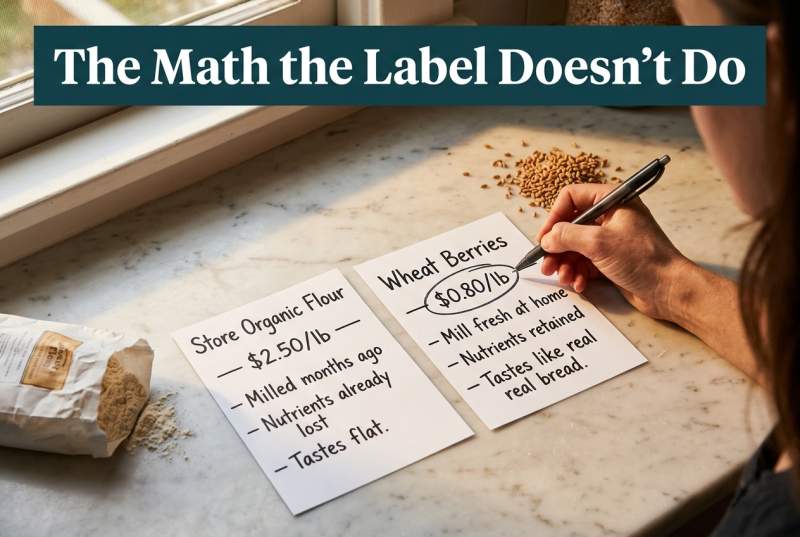
Here's a number worth sitting with. Organic wheat berries — the whole, unmilled grain — cost between $0.60 and $1.50 per pound. You can buy a 25-pound bag, store it sealed, and use it over months.
Organic whole wheat flour from the same grocery store you're shopping at right now costs $1.50 to $3.00 per pound — for a product that has already been industrially milled, had the majority of its original nutrients removed, had synthetic vitamins added back, and then spent an unspecified amount of time in a warehouse and on a retail shelf. You are paying a premium for a product that was nutritionally diminished before you bought it.
And when your family won't eat the bread you baked with it — the loaf that was supposed to be the healthier choice — you've paid that premium for a result nobody at the table wanted. This is the pattern that home millers talk about when they describe their turning point. Not a single dramatic event. Just the accumulation: the loaf that didn't get finished, the organic bag that cost $6, the family who asked for "the other bread."
The question worth asking before your next grocery run isn't "which flour should I buy?" It's "why am I buying flour at all — when the wheat itself is cheaper, more nutritious, and lasts longer?"
Source: Harvard T.H. Chan School of Public Health — nutrient data; USDA commodity pricing for wheat berries and organic flourOnce you understand what's actually inside that bag, the frustration finally makes sense. The problem with whole wheat bread in most households isn't the wheat. It isn't the recipe. It isn't your baking skills. It's the flour — and specifically, what has already happened to it before it ever reached your kitchen.
If you've been wondering why your family resists the healthier choice you're trying to make, this is why — and there is a direct solution. See how the FreshGrain Mill addresses this →
What Home Milling Actually Solves

Home grain milling is the process of grinding whole wheat berries — the intact, unprocessed grain — into fresh flour immediately before you bake. Nothing is removed. Nothing synthetic is added. You control every step between the grain and the loaf.
This is why the taste difference is the first thing every home miller talks about. Not the nutrition charts. Not the cost comparison. The bread that their family actually wanted to eat. The FreshGrain Mill makes this accessible at a price point designed for the baker who wants to try fresh milling before committing to a $300–$600 stone burr mill.
3 Steps to Verify Fresh-Milled Results Before You Commit
Mill a Test Batch
Put whole wheat berries in. Press one button. You have fresh flour in under 60 seconds. Smell it — fresh-milled flour has a distinct nutty aroma that store flour, even premium organic, does not have.
Bake the Same Recipe
Don't try a new recipe. Use the one your family already accepts. Swap only the flour. The variable you're testing is the flour, not the recipe. Your family's response is the data point.
Apply the 30-Day Window
You have 30 days from delivery to test this with your actual family, in your actual kitchen, with your actual recipes. If your family doesn't respond differently to the bread — send it back. No questions asked.
What Researchers Who Tried This Discovered

The category insight that keeps appearing across home-milling communities and food-health research isn't about the mill. It's about the moment the flour changes and the family changes with it. A registered dietitian — someone trained for years to understand food and nutrition — described her first encounter with fresh-milled flour in terms that most home bakers will recognize.
The same pattern appears across independent home-milling communities, sourdough forums, and family food blogs — not as a coordinated marketing message, but as an organic recurring phrase: "I'm never going back to store flour." That phrase matters to you right now — before you've purchased anything — because it's the most important question to answer: will the difference be real enough to change how my family eats? The 30-day guarantee exists specifically so you can answer that question with your own family, in your own kitchen, before you've committed to anything.
Commercially made whole grain bread will never be a fan favorite. It tastes yucky.— Hope This Werks, home baking community
This is the gap the FreshGrain Mill is designed to close — not with marketing language, but with a 30-day, in-your-own-kitchen test. Try the FreshGrain Mill for 30 days →
"But Isn't a $79.99 Mill Going to Be Unreliable?"

This is the right question to ask before you buy — and the home-milling community asks it loudly. The honest answer: the FreshGrain Mill is an entry-level appliance, not a stone burr mill that costs $400. It is designed for one purpose: to let you test whether fresh-milled flour makes a real difference in your kitchen before you spend $400 on a lifetime investment.
That is the reason the 30-day money-back guarantee exists. You're not being asked to trust a $79.99 appliance with your family's food long-term on day one. You're being given 30 days to bake with it, taste the difference, watch your family's response, and decide. If the results don't justify keeping it — it goes back.
The test has no cost. The question is whether you're willing to run it.