9.8
Our Score
★★★★★ Editors' Pick
7 Reasons the FreshGrain Mill Wins Every Flour Comparison (And Why the Math Is Even Better Than the Ads Show)
You have been comparing grain mills. You already know store flour is stripped. Here is the number nobody puts in the headline: your organic flour costs $3.00 a pound. The wheat inside it costs $0.80. The other $2.20 is the bag, the brand, and the warehouse.

Quick Summary
The FreshGrain Mill lets you skip the markup on every bag of flour you have ever bought — wheat berries cost $0.60–$1.50/lb versus $1.50–$3.00/lb for organic flour, and the mill pays for itself in roughly 4 months at 2 loaves a week. Fresh flour retains significantly more nutrients than store flour (Harvard T.H. Chan confirms industrial milling removes more than 50% of B vitamins and roughly 90% of vitamin E). At $79.99 with a 30-day money-back guarantee, this is the entry point the grain-milling community has been waiting for.
You are not here because you just discovered grain milling. You are here because you have compared the options, seen what established mills cost ($300–$890, most on backorder), and you want to know whether this one actually delivers. Fair. Here are seven specific reasons — with the data — to make that decision now.
What Changes for You
1
Every Flour You Have Bought Promised Freshness. None Delivered It.
Every bag of organic flour on that shelf promised you better nutrition. None of them disclosed that the wheat inside was milled months ago, that industrial processing removed more than 50% of B vitamins and roughly 90% of vitamin E (Harvard T.H. Chan School of Public Health — verified), or that the US government's response is mandatory synthetic enrichment that replaces only a fraction of what was lost.
The organic label does not stop oxidation. The premium price does not stop warehouse time. And the price itself — $3.00 a pound for something that cost $0.80 a pound in grain — is not a nutrition premium. It is a packaging, branding, and distribution premium. You have been paying for the supply chain, not the food.
The FreshGrain Mill changes one specific thing: the moment of milling moves from a factory floor to your kitchen counter. The flour your family eats is fresh — not months-old — every single time.

2
The KitchenAid Attachment Is Damaging Your Mixer
This is the most documented trap in the grain-milling category — and no brand talks about it.
A KitchenAid grain mill attachment costs $100–$150. It overheats the mixer, produces coarse and inconsistent flour, has a 10-cup capacity limit, and risks burning out a $300–$400 appliance. A KitchenAid repair professional publicly advises against it: "Mr. Mixer, who repairs KitchenAid mixers, advises against using a grain mill attachment as it is hard on the mixer." (SourdoughHome — verified.)
You would be spending $100–$150 on an accessory that endangers a $400 investment to produce flour a dedicated mill makes better. The FreshGrain Mill is a standalone unit. Your mixer does nothing. Your mixer stays safe.
$79.99vs. $100–$150 KitchenAid attachment + risk to $300–$400 mixer
3
Your Sourdough Is Being Held Back by Its Own Ingredient
The sourdough community has a phrase for what happens when you switch to fresh-milled flour: "game changer." It appears across dozens of independent baking blogs with no commercial motivation. "Took my bread to another level." These are not marketing phrases — they are the organic consumer vocabulary of bakers who made the switch.
The reason is structural. Fresh-milled flour contains the whole grain — the bran, the germ, the endosperm — intact. The fermentation profile changes. The crumb opens. The crust deepens. And because you control the grind, you can adjust texture from loaf to loaf.
You have built the skill. You have the starter. Fresh flour is the one upgrade that changes the ingredient itself — not the technique.

Why It Works
4
One Mill. Wheat, Rice, Oats, Quinoa — All of It.
The FreshGrain Mill is not a wheat-only tool. It mills the full range of whole grains your kitchen actually uses: wheat berries, rice, oats, quinoa, and more. One appliance replaces a rotating cast of specialty flours — each sold in a separate bag, at a separate markup, with a separate warehouse timeline.
Buckwheat flour for pancakes. Rice flour for gluten-sensitive baking. Oat flour for cookies. Every one of those bags you no longer need to buy is money you keep — and flour that is milled the morning you bake it rather than three months before you opened it.
The 300g stainless steel milling chamber handles each grain type cleanly, and the food-safe surfaces mean no flavor transfer between milling sessions.

5
Every Alternative You Tried Has Already Failed
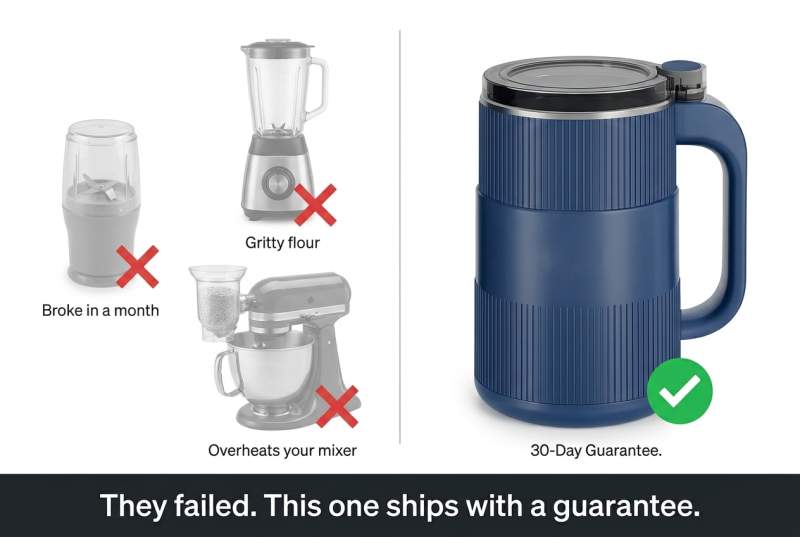
You have likely run this experiment at least once already. A cheap Amazon blade grinder at $40–$80 that broke within a month ("I had bought a cheapish $80 one on Amazon and it broke after a month" — Country Living customer, verified). A blender or food processor that produced gritty, inconsistent results. A KitchenAid attachment that overheated and still did not make good flour. And established mills at $300–$890 that were out of your budget — or on backorder.
The FreshGrain Mill sits at the exact price point the community has needed: $79.99 with a 30-day money-back guarantee that the $40 Amazon grinder never offered. The community says "all the mills costing less than $400 were more like toys." The guarantee is our answer to that objection: if this mill does not perform, you are not stuck with it.
30Days to return it. Free shipping. No questions.
6
The Flour Starts Losing Nutrients the Moment It Is Milled — Whether You Buy the Bag or Grind It Yourself
Here is the honest science — which no competitor discloses.
Industrial milling removes more than 50% of B vitamins, roughly 90% of vitamin E, and nearly all fiber from wheat. That damage happens at the factory, and it is permanent. The US government mandates synthetic enrichment (21 CFR 137.165) that replaces only a fraction of what was lost, using lab-manufactured vitamins. Harvard T.H. Chan School of Public Health confirms all of this. These are verified facts.
Additionally, potassium bromate — a flour processing chemical banned in the EU, Canada, the UK, Brazil, and China — remains legal in US flour production. You have no way of knowing whether it is in your bag.
When you mill at home, the grain is whole until the moment you grind it. You control what goes in. You know exactly what comes out. And the flour that reaches your family's bread was milled that morning — not three months ago in a facility you have never visited.
"I cried! Real, unexpected tears... even after years of working as a dietitian, I had been missing something so foundational." — Christa Joy, Registered Dietitian (verified)
>50%B-vitamin loss from industrial milling — that fresh-milled flour bypasses

Why Now
7
You Have Already Spent More Than This Mill Costs on Solutions That Did Not Work
Add it up. One bag of organic flour a week at $3.00 per pound, two pounds per loaf, two loaves a week: $624 a year. Year after year. You paid a premium for organic certification that does not stop warehouse oxidation. You may have bought a KitchenAid attachment ($100–$150) that overheated. You may have bought an Amazon grinder ($40–$80) that broke.
That accumulated spend — conservatively $100 to $200 on failed hardware alone, plus hundreds on premium flour that still depleted on a warehouse shelf — is what the category has cost you before this decision.
The FreshGrain Mill costs $79.99. One purchase. Free shipping. 30 days to return it. At 2 loaves a week using wheat berries at $0.80 per pound, the mill pays for itself in roughly 4 months. After that, every loaf costs you $0.95. The same loaf at the store: $5 to $8.
Five-year comparison: Keep buying organic flour at $3.00/lb for 2 loaves/week → $1,560. Switch to wheat berries at $0.80/lb with a one-time $79.99 mill → $496. You keep $1,064 in 5 years. And every loaf is fresh.

FreshGrain Mill vs. Every Other Option
Feature
Other Options
FreshGrain Mill ★ Winner
Price
$100–$150 + $300–$400 mixer (KitchenAid) · $40–$80 (Amazon) · $300–$890 (premium mills)
$79.99 — standalone, no hidden costs
Motor Risk to Other Appliances
Yes — KitchenAid attachment causes documented mixer damage
None — dedicated standalone unit
Availability
Most premium mills on backorder March 2026; Amazon grinders break quickly
In stock, ships free
30-Day Money-Back Guarantee
❌ No — KitchenAid attachment, Amazon grinders offer no return window
✅ Yes — full refund, no questions
Grains Supported
Wheat primary (KitchenAid, premium mills) · Wheat and spices (Amazon)
Wheat, rice, oats, quinoa, buckwheat, millet, and more
Beginner's Guide Included
❌ No — none include hydration charts, conversions, or adjustment guidance
✅ Yes — included with every order
Per-Loaf Cost (amortized)
~$0.95 + mixer risk (KitchenAid) · Breaks before payback (Amazon) · ~$0.95 after $300–$890 investment (premium)
~$0.95 — after a $79.99 one-time purchase
🌾 FreshGrain Mill — $299.00 $79.99 · Free Shipping · 30-Day Money-Back Guarantee
Try It Risk-Free →
>50%
B-Vitamin Loss from Industrial Milling (Harvard)
~90%
Vitamin E Removed by Industrial Refining (Harvard)
$0.95
Per-Loaf Cost vs. $5–$8 Store Organic
~4 mo.
To Full Payback at 2 Loaves Per Week
CJ
Christa Joy
Registered Dietitian
⭐⭐⭐⭐⭐
"I cried. Real, unexpected tears."
"I'll never forget the day I discovered the truth about fresh milled flour. I cried! Real, unexpected tears... even after years of working as a dietitian, I had been missing something so foundational."
✅ Verified Dietitian
⭐⭐⭐⭐⭐
"Alive vs. dead — it's really true."
"I now call fresh-milled flour 'alive' and store-bought flour 'dead.' And it's really true."
✅ Verified Review
GA
Generation Acres Farm
Family of 6
⭐⭐⭐⭐⭐
"All 4 of us with gluten intolerance have zero issues."
"Out of the 6 people in my immediate family, 4 of us have varying levels of gluten intolerance. All 4 of us can eat as much of these breads, muffins and rolls from the grains milled at home and we have zero issues." (Anecdotal; individual results vary.)
🛡️
30-Day Money-Back Guarantee — No Fine Print
Mill fresh flour every day for 30 days. Bake with it. Compare the cost. Compare the flavor. If for any reason the FreshGrain Mill does not deliver what this advertorial promised, return it within 30 days for a full refund. Free shipping on the way in. No questions on the way back.
This is the guarantee the $40 Amazon grinder never offered you. It is the reason the risk calculation on this purchase is different from anything else you have tried in this category.
Is FreshGrain Mill Right For You?
Perfect for you if
- You bake sourdough and want to change the ingredient itself, not just the technique
- You already buy organic or premium flour and want to stop paying for the bag
- You have a KitchenAid and want to mill grain without risking your mixer
- You want to try home milling without committing $300–$890 to find out if you love it
Not for you if
- You want a stone burr mill — this is an entry-level blade-style mill, not a MockMill equivalent
- You bake commercially — the 300g chamber is sized for home baking, not production volume
- You are not willing to learn — fresh-milled flour bakes differently; your first loaf may need adjustment (the included beginner's guide addresses this)
Our Verdict
9.8/ 10
The FreshGrain Mill does one thing the $300–$890 mills cannot do: it lets you start milling today for $79.99 with a 30-day return window if it does not earn its place in your kitchen. The per-loaf math is real, the nutrition case is Harvard-sourced, and the guarantee removes the only remaining objection. If you have been comparing mills and talking yourself out of the commitment — this is the entry point the category has needed.
🌾 Ready to Stop Paying for the Bag?
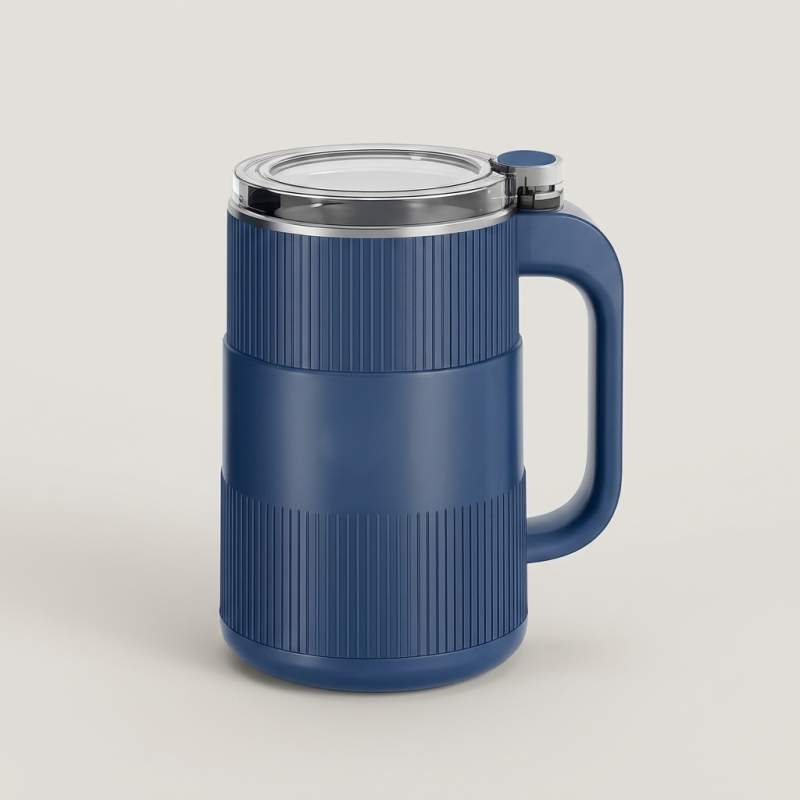
FreshGrain Mill
⭐⭐⭐⭐⭐
Today's Price
$79.99$299.00
⚠️ Established mills (MockMill, NutriMill, KoMo, Country Living) are currently on backorder. FreshGrain Mill ships now.
In Stock — Free Shipping — Limited Availability
✅ Free Shipping↩️ 30-Day Money-Back Guarantee📦 In Stock, Ships Now🔒 Food-Safe Stainless Steel
Still Not Sure?
Is this the same as a cheap Amazon blade grinder?
No — and here is the specific difference: a 30-day money-back guarantee and free shipping change the risk entirely. Cheap Amazon grinders at $40–$80 come with no return window and have a documented failure rate (one customer reported hers broke within a month). The FreshGrain Mill is $79.99 with a full refund window. You are not betting on it — you are testing it.
Will my first loaf be perfect?
Probably not — and we are the only brand that will tell you that directly. Fresh-milled flour absorbs moisture differently than store flour. Bakers consistently report needing to adjust hydration and fermentation times on the first few loaves. Every FreshGrain Mill order includes a beginner's guide with hydration charts, recipe conversions, and the three adjustments every new miller needs to make.
How does this compare to established mills (MockMill, NutriMill, KoMo)?
Those are stone burr mills in the $300–$890 range — a different mechanism and a different price tier. Most are currently on backorder. The FreshGrain Mill is an entry-level dedicated grain mill at $79.99. It is the right way to find out whether home milling transforms your baking before you commit $400+. Many committed millers started exactly this way.
What grains can I mill?
Wheat berries, rice, oats, quinoa, buckwheat, millet, and other dry whole grains. The 300g stainless steel chamber handles the full range of grains used in everyday home baking.
This advertorial contains verified nutritional data sourced from Harvard T.H. Chan School of Public Health and cited regulatory sources (21 CFR 137.165). Testimonials reflect individual experiences and results will vary. Per-loaf cost calculations are derived from verified price ranges for organic wheat berries ($0.60–$1.50/lb) and organic flour ($1.50–$3.00/lb) at a frequency of 2 loaves per week. Payback timeline of approximately 4 months is a derivation from these verified inputs and is not a guarantee of individual savings. Gluten-intolerance anecdote is individual and not clinically validated. This product is not intended to diagnose, treat, cure, or prevent any disease.