Before You Buy Another Bag of Whole Wheat Flour, Read This
If you've been baking with the "good" flour — organic, whole grain, stone-ground — and still feel like something's off about your loaves, your instinct is probably right. Here's the part of the story the bag doesn't tell you.

You know the feeling. You pull a loaf out of the oven and it's fine. Honestly, it's fine. The crust has some color, the crumb is edible, your family eats it without complaint. But it isn't the bread you were picturing when you started baking. It's a little dense. A little flat. The flavor is somewhere between bland and faintly bitter, and no amount of hydration adjustment or longer autolyse has quite fixed it.
So you blame yourself. Your technique. Your oven. Your starter.
What almost nobody tells you — and what the flour aisle at your grocery store has zero incentive to mention — is that the flour itself might be the oldest, stalest ingredient on your counter. Even the bag that says "whole wheat." Even the one that says "stone-ground." Even the organic one with the pastoral farm scene on the label.
Wheat berries are living things. They contain bran, germ, and endosperm — the three components that make whole grain flour nutritionally whole. The germ, in particular, contains natural oils. Those oils are what give fresh-milled flour its faint sweetness, its complexity, that smell people describe as warm and almost nutty when the grain first breaks open.
Those oils also go rancid.
Not dramatically, not all at once. Gradually — the way a cut apple browns, or the way olive oil slowly turns. Commercial mills grind the grain weeks or months before it reaches your store. Then it sits in a distribution warehouse. Then it sits on a shelf. By the time you crack the paper seal, that flour has been milled for a long time. The bag doesn't have to tell you how long. There's no rule that requires it.
This isn't a fringe concern or a homesteading-blog talking point. The research behind it comes from mainstream nutrition science. And it changes what "whole wheat flour" actually means.
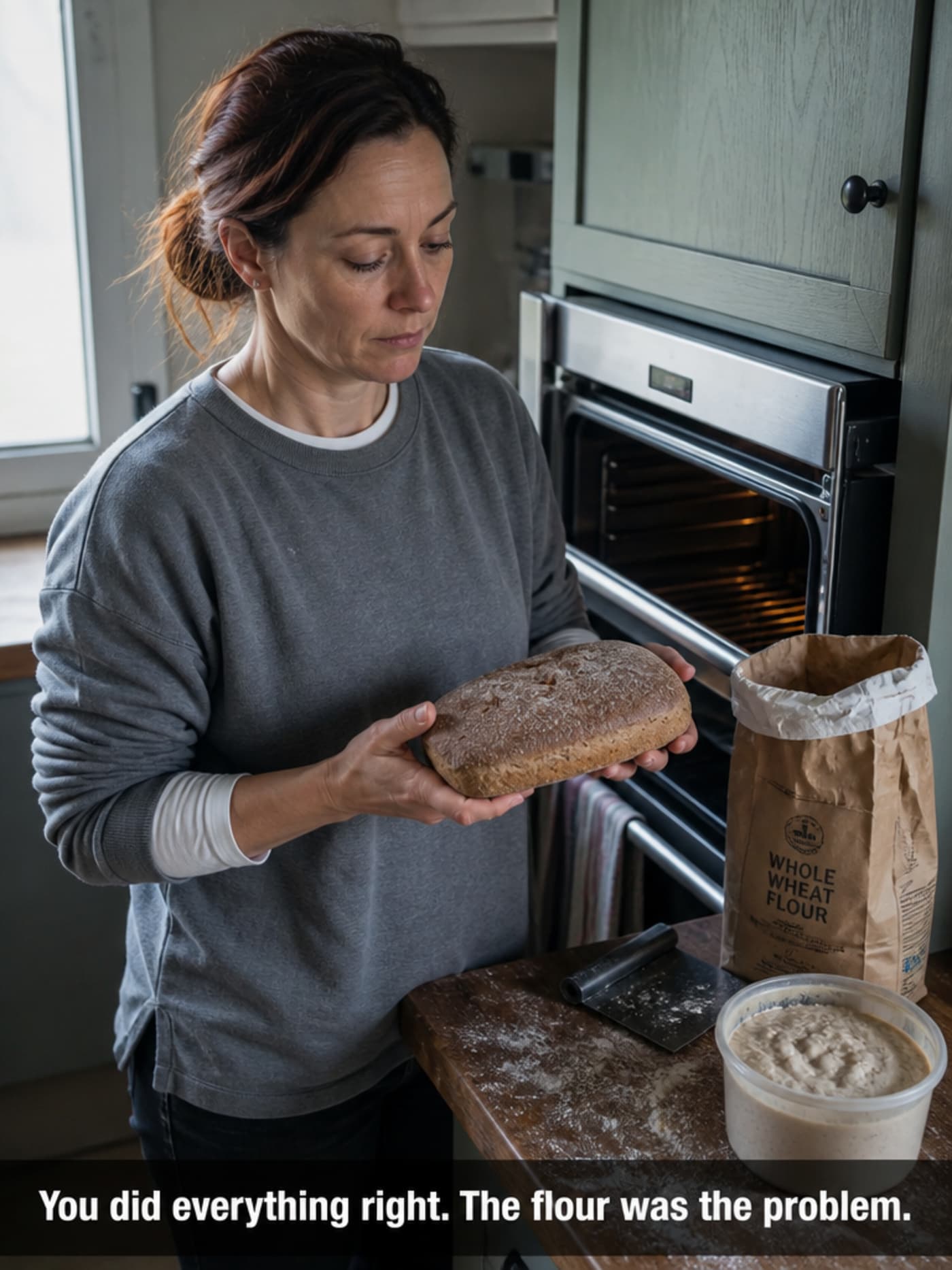
Here's what most home bakers do when the loaves aren't working: they upgrade the flour.
They move from generic store-brand whole wheat to the specialty mill brand. They switch from conventional to organic. Some go further — they buy the stone-ground bag from the small regional mill with the beautiful typography on the label. Each upgrade is real, and each one helps a little. Better sourcing, better wheat variety, better milling practices. These things matter.
But none of them solve the milling-date problem.
Why What's Out There Falls Short
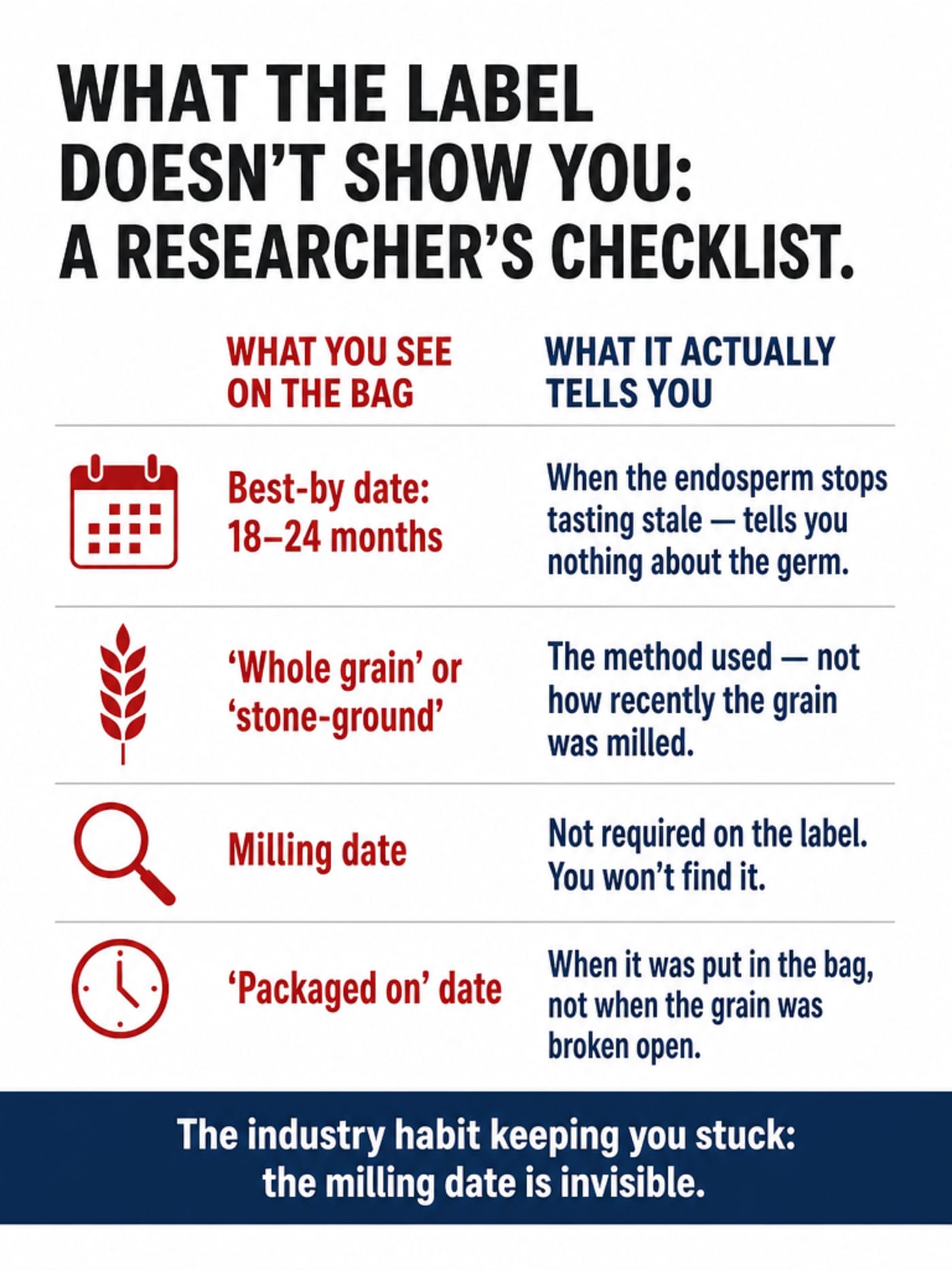
The category habit that keeps bakers stuck isn't buying bad flour. It's buying old flour — flour that was ground long before it reached them, then stored in conditions that accelerate oxidation, then sold with a best-by date measured in years because the endosperm (the starchy part) doesn't go rancid, even when the germ does.
Here's what to watch for on your next bag of whole wheat flour: look for the milling date. Not the best-by date. Not the "packaged on" date. The milling date — when the grain was actually broken open and ground. You won't find it, because it isn't required. You'll find a best-by date stamped 18 to 24 months out. That tells you when the endosperm stops tasting fresh. It tells you nothing about the germ.
"I call it dead flour versus alive flour — and it's really true. Once you've baked with fresh-milled, you can't go back to the bag."
Stone-ground on the label means the method. It doesn't mean recent. "Whole grain" means the component parts were included — it doesn't mean they're still intact, still chemically active, still doing what they do in a freshly milled grain. The problem isn't the brand. The problem is a supply chain that makes milling date invisible and gives you no way to evaluate freshness before you buy.
The Diagnostic the Flour Aisle Won't Give You

Here is the part that most flour conversations — even the good ones — skip past. The research on wheat grain nutrition distinguishes very carefully between what's in the whole berry at harvest and what survives commercial milling and storage. Harvard's nutrition researchers put figures to it: the refining process strips more than 50% of B vitamins from wheat, 90% of vitamin E, and essentially all of the fiber that lives in the bran.
That's refining — white flour. Most people know that part. What's less discussed is what happens to whole wheat flour over time. The germ, which commercial millers sometimes add back into "whole wheat" flour after milling (and which in whole-grain milling was never removed), contains oils that oxidize. The bran fractions lose volatile aromatics. The live enzymatic activity of a freshly milled grain — the thing that makes fresh-milled bread taste different, behave differently in fermentation, develop differently in the oven — diminishes with storage.
This is not a claim about any specific bag. It's basic food chemistry. A freshly milled grain has not yet had time to oxidize. A grain milled months ago has. The shift in how to evaluate flour, then, is this: stop asking "is this whole grain?" Start asking "when was this milled?" A bag of organic stone-ground whole wheat that was ground four months ago is a different ingredient than flour ground this morning. The bag calls them the same thing.
Source: Harvard T.H. Chan School of Public Health — The Nutrition SourceThe milling date question doesn't resolve itself at the grocery store. No label answers it. But once you understand what you're actually looking for, every bag of "whole wheat" flour looks different.
The only way to know when your flour was milled is to mill it yourself. See what that looks like in practice →
The Solution — and How to Verify It Yourself
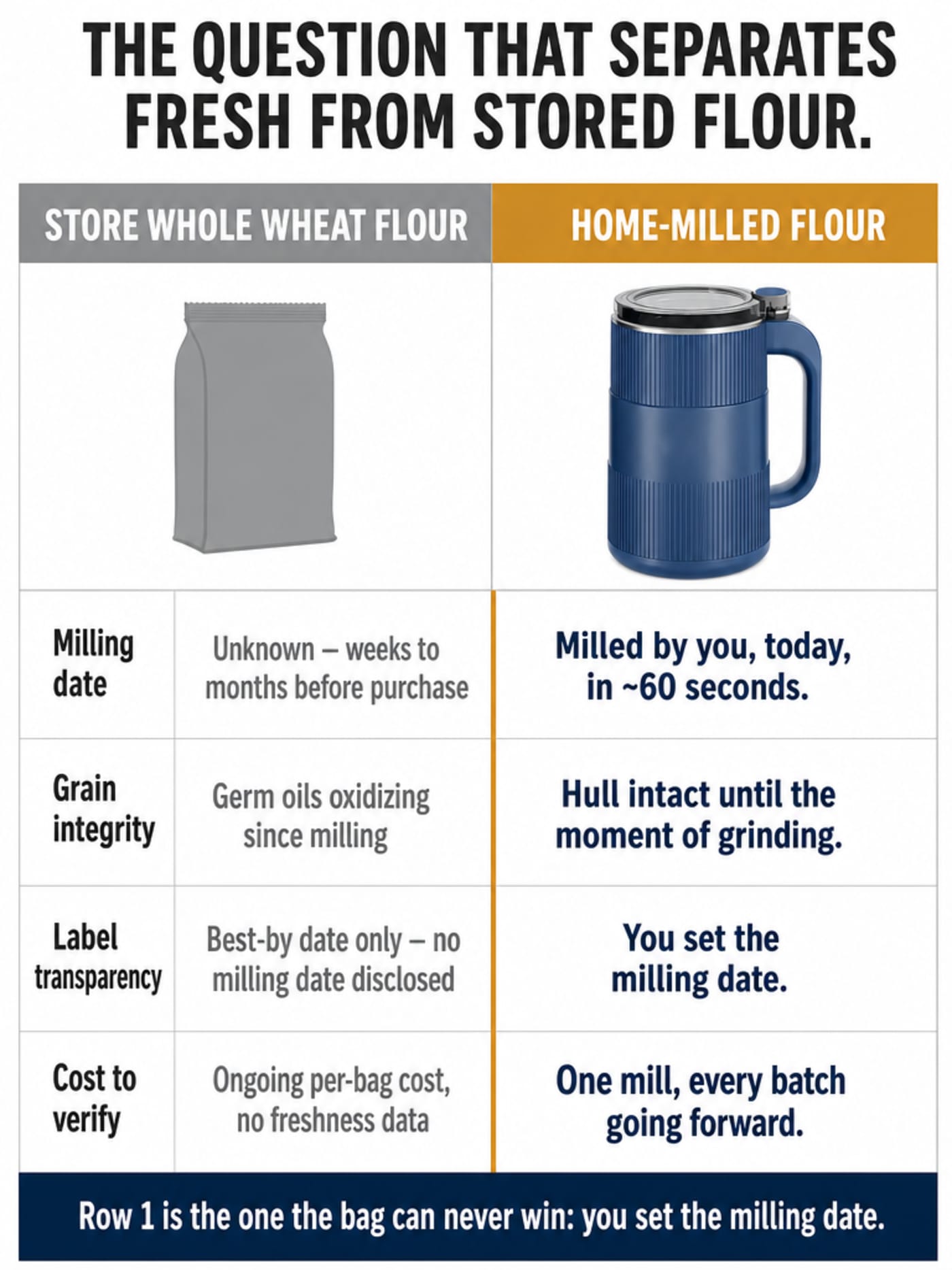
The only way to know when your flour was milled is to mill it yourself — and until recently, that meant a $300 to $900 countertop stone mill, a meaningful commitment for something you weren't sure you'd actually use. The shift in the category over the last few years is that smaller, accessible electric grain mills have made the entry point low enough to actually try. The mechanism is straightforward: whole wheat berries — sealed in their natural hull, stable for months or years at room temperature — go into the hopper. A high-speed impact grinding mechanism breaks them open. Flour comes out. The whole process, for a standard home baking batch (about 300 grams), takes roughly 60 seconds.
What matters for the freshness question: the grain is intact until the moment it's milled. The bran is present. The germ is present. Nothing has been oxidizing on a shelf. Every loaf starts with flour that is, at most, a few hours old. This is the mechanism: the berry hull acts as a natural preservative — an oxygen barrier. The moment the hull breaks, oxidation begins. Commercial milling breaks the hull and then puts the flour in a warehouse. Home milling breaks the hull thirty seconds before you mix dough. The difference is structural, not a matter of degree.
Three Verification Steps — Before You Buy Anything
Look for the Milling Date
Open your current bag of whole wheat flour and look for a milling date — not a best-by date, not a "packaged on" date. When was the grain ground? If you can't find it, note that. It's not on the bag because it isn't required to be.
Hold a Whole Wheat Berry
Buy a small quantity of whole wheat berries at a co-op or natural grocery store. Hold one between your fingers — sealed, dry, shelf-stable. Compare the smell to your open bag of pre-milled whole wheat. This is the flour, before it becomes flour.
Ask the Manufacturer
Look up your flour's manufacturer and try to find the milling date. Most companies will not be able to tell you. Some will give a general window. Record what you find. These three steps cost nothing and tell you everything the bag doesn't.
What Bakers Who've Made the Switch Actually Report
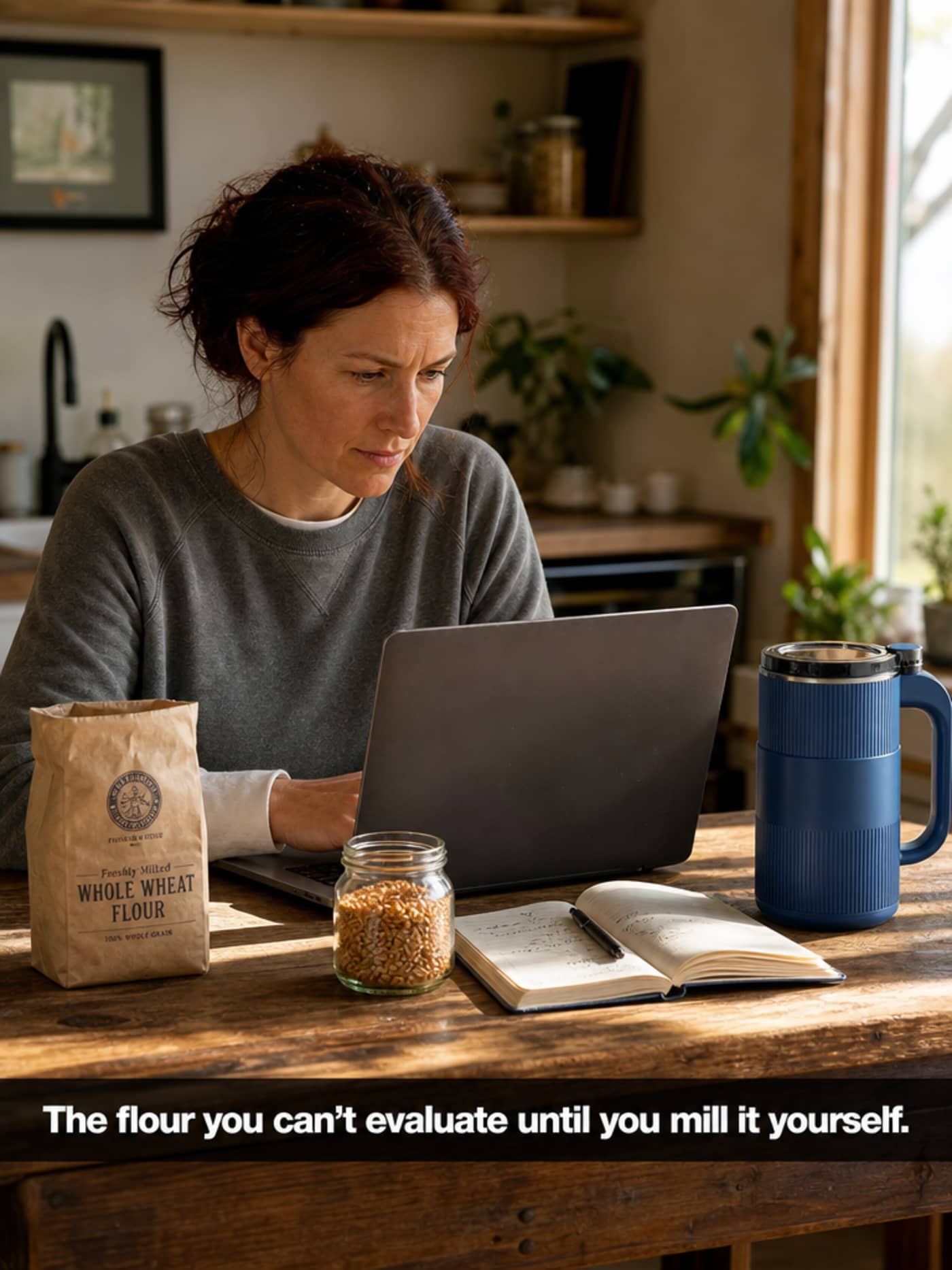
The home milling community has been making this argument for years, but what changed the conversation was the specificity: bakers started documenting exactly what their bread did differently when milled fresh versus bagged.
The fermentation behavior is the most-discussed. Fresh-milled flour has higher enzymatic activity — amylase and protease in particular — which means it interacts with a sourdough starter differently than a shelf-stable pre-milled flour does. Experienced bakers who switched describe the dough as "more alive," which sounds subjective until you watch a fresh-milled loaf develop in a bulk ferment at the same time and temperature as a bagged-flour loaf and see it move differently.
The flavor description is remarkably consistent across independent home bakers in communities like The Fresh Loaf and r/Breadit: a faint sweetness in the crumb, a complexity that reads as slightly nutty, a freshness that doesn't photograph but gets noticed at the table.
The more practical observation: the loaves behave more predictably. This surprises people who expect fresh-milled flour to be harder to work with — and it can be, initially, which is why any serious attempt at fresh milling needs to account for the adjustment period. The bakers who stick with it consistently report that once they calibrate their hydration and timing to the fresher flour, the consistency improves.
"I was racking my brains trying to choose a mill — they're all three hundred, four hundred dollars, sometimes a thousand. I just wanted to find out if I even liked milling before I committed to anything that expensive."
That hesitation — wanting to know if fresh milling is right for you before spending real money on it — is the most common thing said by people who are seriously considering the switch. It's a reasonable hesitation. Here's what Grainbloom includes to make the first bake work →
"Is My First Loaf Going to Be a Disaster?"
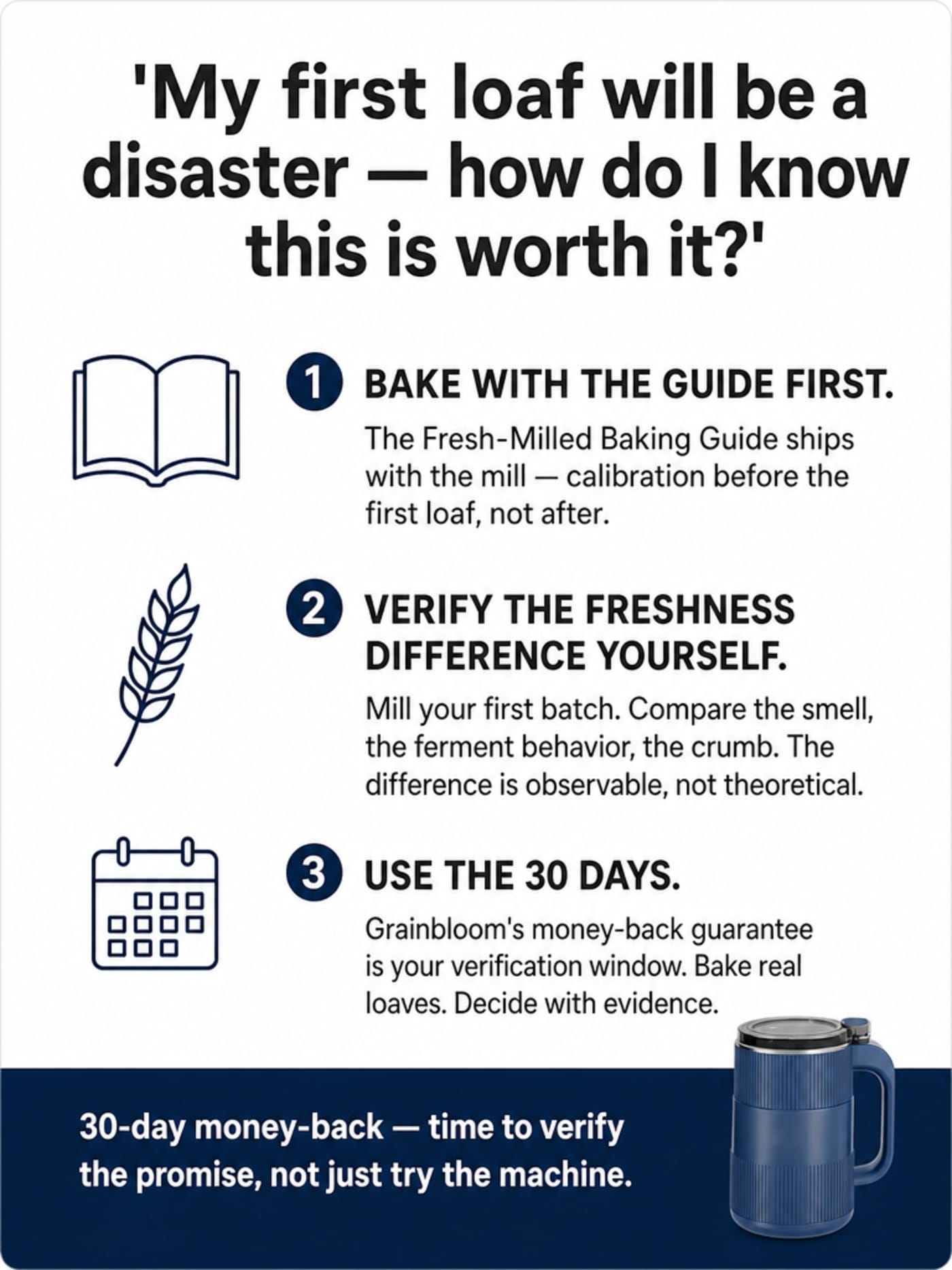
This is a fair question, and the honest answer is: the first loaf might need adjustment. Fresh-milled flour has higher hydration requirements than aged commercial flour. The enzymatic activity is different. The timing on fermentation shifts. None of this is insurmountable — experienced bakers have written extensively on the calibration — but going in without guidance is the most common reason people's first fresh-milled bakes disappoint them and they quietly put the mill in a cabinet.
This is exactly why Grainbloom includes the Fresh-Milled Baking Guide with the mill. Dense, flat, gummy first loaves are the documented number-one reason people abandon home milling in the first weeks. The Guide exists to address the calibration before the first bake, not after. Every loaf starts with flour that is, at most, a few hours old — but you need the right starting point to make the most of that.
If you spend 30 days baking with fresh-milled flour and decide it isn't for you, Grainbloom's 30-day money-back guarantee gives you that time — to actually try the flour, bake real loaves, and verify whether the difference is real for your kitchen and your baking. Not a "contact us and we'll see" policy. The mill comes back, and your money comes back. The guarantee is the verification window — use it.