The Problem With "Whole Wheat" Flour Nobody in the Baking Industry Wants to Talk About
If your from-scratch loaves keep coming out denser than they should, your cookies taste flat no matter what you do, or you've started reading ingredient labels and something just doesn't add up — this is written for you.
You've been doing everything right. You buy the good flour. The bag says "whole wheat," maybe even "stone-ground," and it costs more than the basic white. You follow the recipe carefully — the hydration, the fold schedule, the proofing window. You've read the forums. You've watched the videos. And still, when the loaf comes out, there's something missing. A density you can't quite explain. A taste that's close, but not quite there. A texture that your grandmother's bread never had, and you can't figure out why.
You might have blamed yourself. Maybe your sourdough starter isn't active enough. Maybe you're overproofing. Maybe the oven runs hot. You've adjusted all of it, and the results improved — but not all the way.
Here's what nobody is telling you: the flour you're using was milled weeks or months before it reached your kitchen. Not days. Months. And in that time, something was already happening to it.
Whole grain flour goes rancid. Not dramatically, not in a way that makes it smell obviously wrong — but the fats in the germ, the most nutritionally active part of the wheat berry, begin to oxidize from the moment the grain is broken open. By the time a bag of whole wheat flour has sat in a warehouse, traveled a distribution chain, and spent time on a grocery shelf, that oxidation is well underway. The flour hasn't spoiled. But it also isn't what it was.
The from-scratch bakers who know this don't blame their technique first. They start with a different question: how old is this flour, actually?
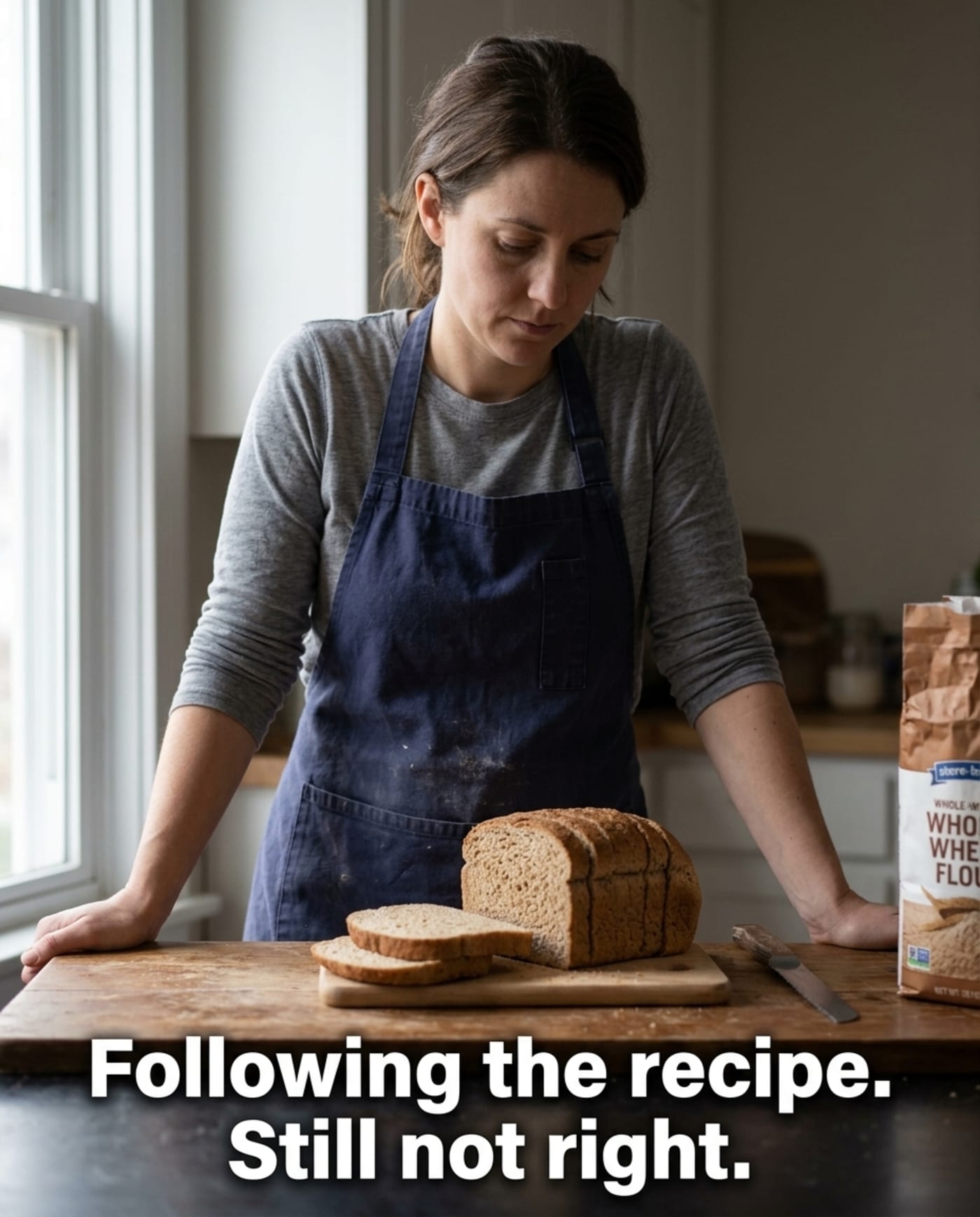
The from-scratch bakers who keep running into the same wall — dense crumb, muted flavor, results that don't match the effort — are not doing something wrong. The ingredient they're working with isn't the same ingredient their great-grandmothers worked with. Flour used to be milled and used. Now it's milled, packaged, stored, and distributed over months. That's the baseline you're baking against. And no amount of technique adjustment fixes a variable that was already decided before the bag was sealed.
Why What's Out There Falls Short
Here's the part that makes this frustrating to research: the flour industry does not hide what it does. It just uses language that sounds like good news.
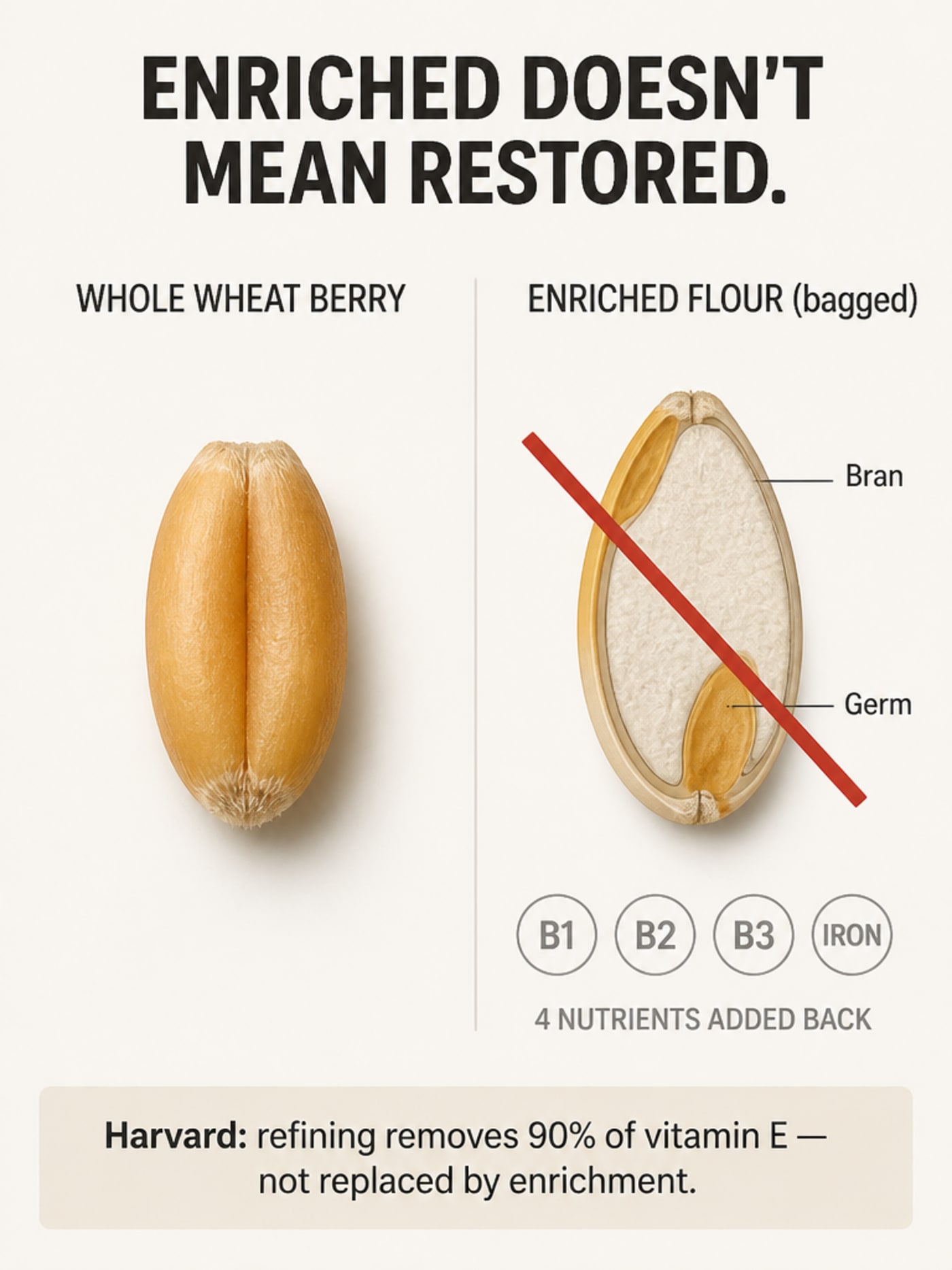
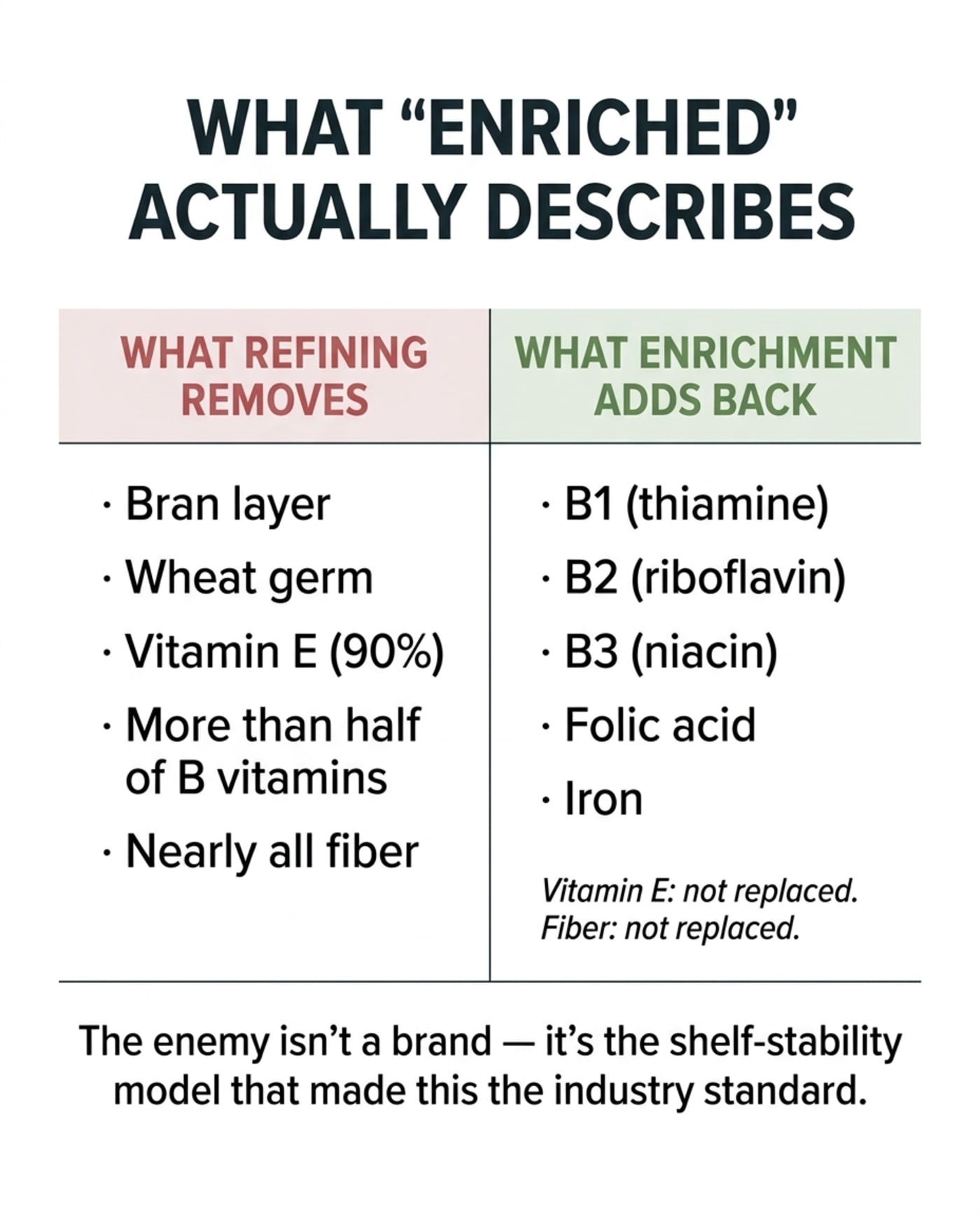
"Enriched." You see it on almost every commercial flour bag, including the ones marketed as whole grain or high-quality. The word sounds like something was added — an upgrade, a benefit. What it actually describes is a specific legal process: refiners strip the bran and germ from the wheat kernel to extend the flour's shelf life, then add back a standardized set of synthetic B vitamins and iron to partially offset some of what was removed.
This is the enemy: not a brand, not a company, but an industry-wide model built around shelf stability — and the "enrichment" story that packages it as nutritional equivalence. The replacement is real. The restoration is not.
I call fresh-milled flour 'alive' and store-bought 'dead' — and it's really true.
That gap matters for bakers before they've bought anything, because it changes what you're actually evaluating when you pick a flour off the shelf. "Whole wheat" can mean the whole grain was milled and nothing removed — or it can mean refined white flour with some bran added back in. The label doesn't always tell you which. "Enriched whole wheat" is nearly always the second version. And even when a bag genuinely contains whole grain flour, the clock started ticking the moment it was milled.
The Pattern Interrupt: What You've Been Told Vs. What's Actually in the Bag
The standard advice in baking forums is to upgrade your technique when your results disappoint. Buy better flour. Use a digital scale. Get your starter more active. All of that helps, and none of it is wrong. But it leaves one assumption completely unquestioned: that the flour you're starting with is whole, fresh, and intact.
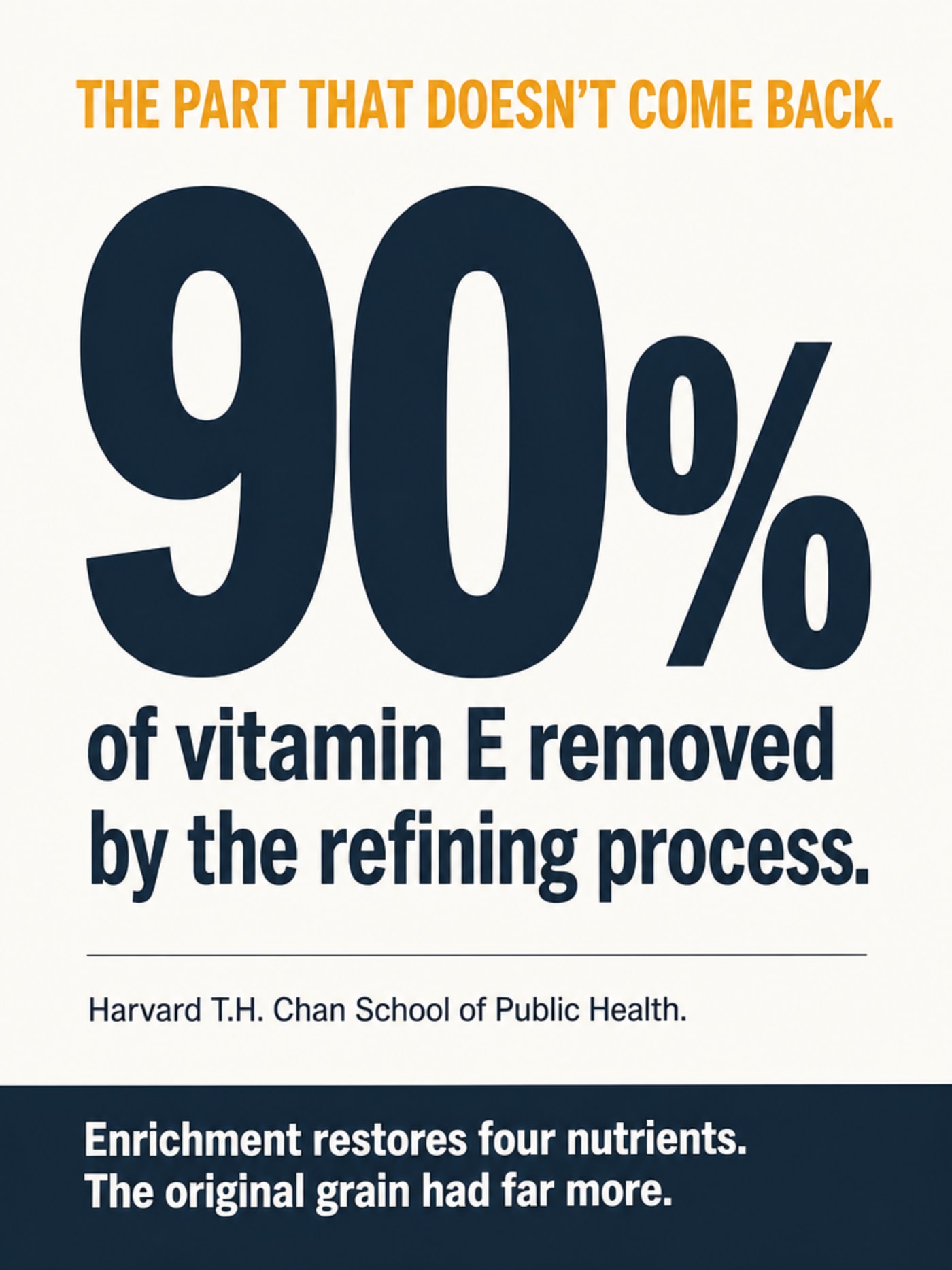
According to the Harvard T.H. Chan School of Public Health, the refining process strips more than 50% of B vitamins, 90% of vitamin E, and nearly all of the fiber present in the original wheat kernel. The enrichment process that follows restores four B vitamins and iron — a partial list. Vitamin E is not on it. The fiber is not on it.
Harvard T.H. Chan School of Public HealthThis is where the diagnosis shifts. Most bakers who feel dissatisfied with their results are asking: Am I doing this correctly? The more useful question is: What is actually in the ingredient I'm using — and is it the same thing I think it is?
When you bake with flour that was milled months ago, you are not starting with whole grain. You are starting with a grain that was broken open, allowed to oxidize, possibly stripped and partially reconstituted, and packaged to last on a shelf. The technique question is secondary. The ingredient question comes first.
The pattern that keeps bakers stuck — adjusting ratios, tweaking processes, buying premium versions of the same fundamental product — breaks only when the ingredient itself changes. See what changes when the flour is milled fresh →
The Solution: Fresh-Milled Flour and How It's Different
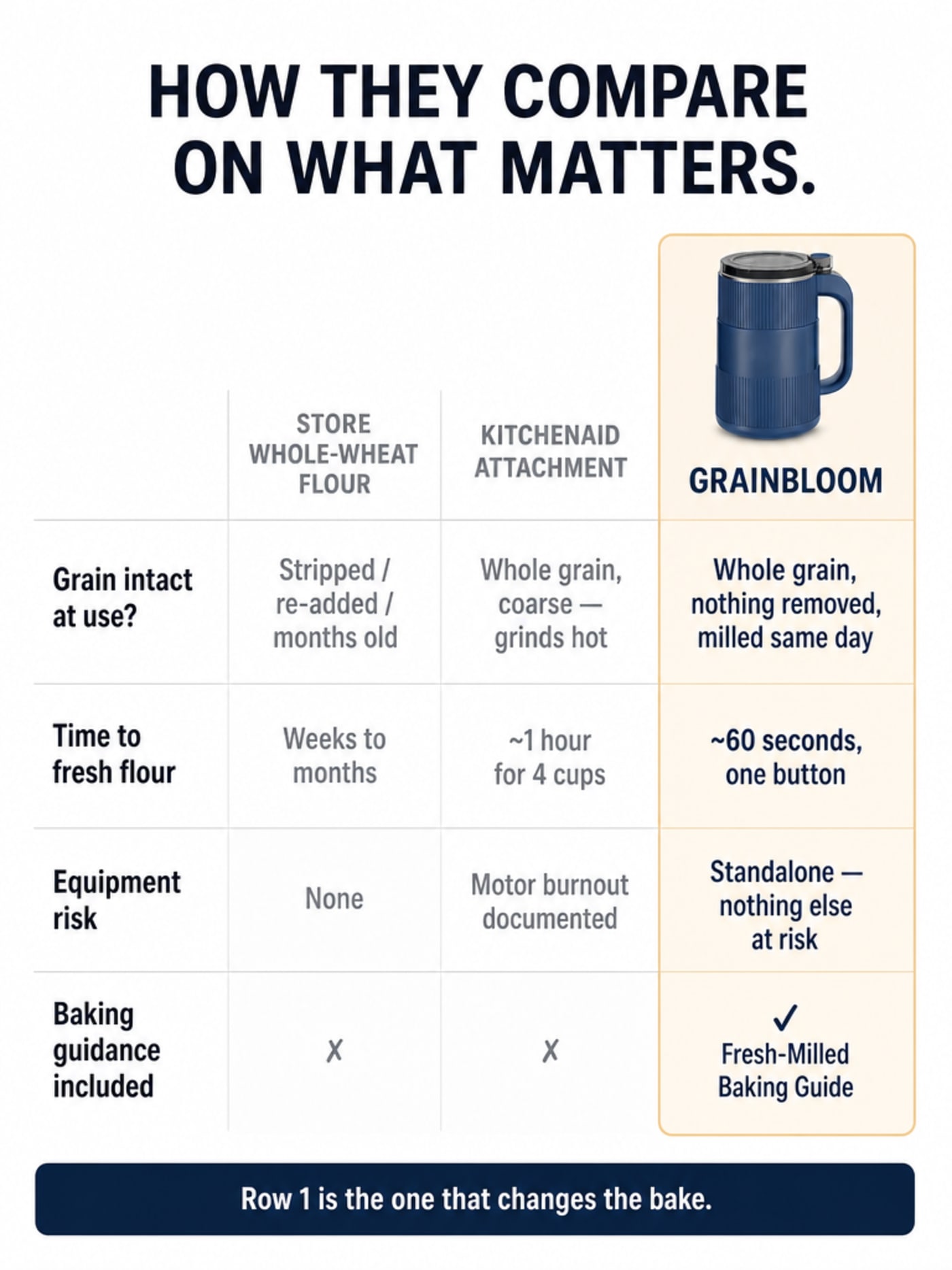
The fix is older than the problem. For most of human history, grain was milled as it was needed. Not in industrial quantities weeks ahead of use — in the kitchen, for the week's baking, from the whole grain. The germ and bran stayed in. The flour was used before it could oxidize. The result was nutritionally whole and, by most accounts, better-tasting than what we accept today as standard.
A countertop grain mill brings that logic back into a modern kitchen without requiring a lifestyle overhaul. A high-speed impact milling mechanism draws dry wheat berries — the intact, unhulled whole grain — from a hopper and processes them between two grinding surfaces at high rotational speed, breaking the grain progressively from whole berry to coarse meal to fine flour. Because the grain is processed whole, the bran, germ, and endosperm are all present in the finished flour. Nothing is separated out, nothing is recombined. The flour exits the mill at the grind fineness you set and is ready to use immediately — there is no packaging delay, no warehouse, no shelf time. Milled this morning means milled this morning.
Three Things to Verify Before You Buy
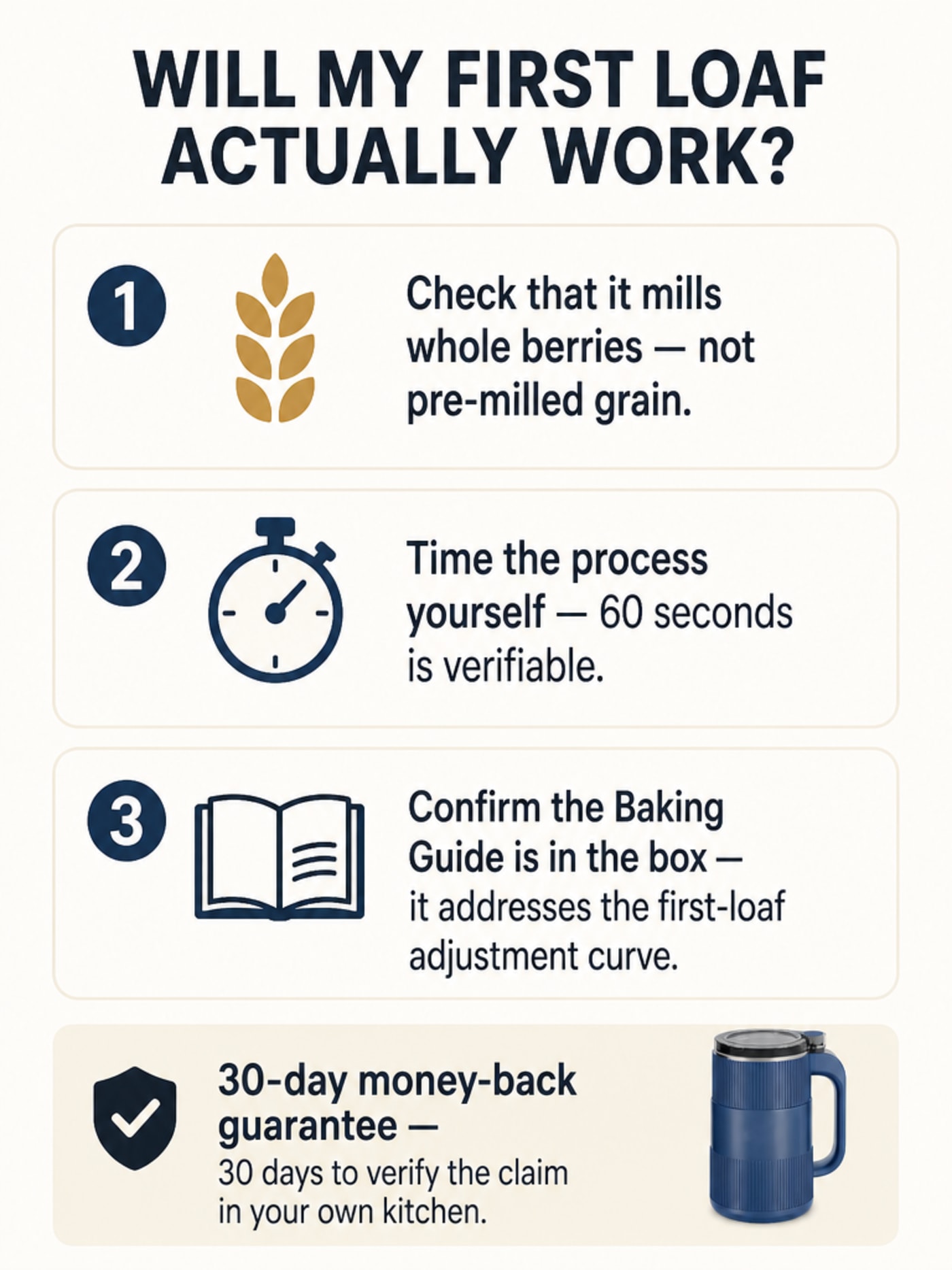
Check for whole-berry capability
An impact mill takes the whole, raw wheat berry start to finish. Some devices marketed as "grain mills" are re-grinders — they process pre-milled flour, not whole berries. Look for explicit whole-berry capability in the product description.
Time the process yourself
The KitchenAid grain attachment is documented to take roughly an hour for four cups. A dedicated countertop mill processes a full batch in about 60 seconds. If a reviewer doesn't mention time, it probably wasn't impressive.
Confirm the Baking Guide is in the box
Fresh-milled flour behaves differently from commercial flour. Without guidance calibrated to fresh-milled behavior, first loaves frequently disappoint and beginners quit before the ingredient has a fair test.
What Bakers Who've Made the Switch Actually Report

The experience of switching to fresh-milled flour is specific enough that it shows up in consistent, independent accounts across baking communities — not vague satisfaction, but particular observations about taste, texture, and what the process actually involves.
Bakers who've made the transition frequently describe a moment of recalibration: the dough behaves differently, the proofing timing shifts, the crumb changes in ways they weren't expecting. The learning curve is real — and it is navigable with the right guidance.
The Fresh Loaf, one of the oldest and most substantive home-baking communities in the United States, has running threads on fresh milling where this comes through clearly. One member, weighing the decision before buying anything: "I am racking my brains out trying to choose one… they are $1,000!" Another, whose logic captures exactly what a beginner-friendly entry point offers: "Play with what I can easily buy and see if I even like it… AND THEN… I'd go out and buy a NutriMill."
That second quote is worth staying with. The case for starting with an accessible, lower-commitment mill is not that the premium mills are wrong — it's that the decision to spend several hundred dollars before you've baked a single fresh-milled loaf is genuinely hard to justify. The experience of fresh milling is different enough from baking with commercial flour that it deserves a trial, not a bet.
Play with what I can easily buy and see if I even like it — and THEN go out and buy a NutriMill.
The bakers who report the most frustration with fresh milling are almost always the ones who started without adjustment guidance, got a flat loaf or two, and concluded the process didn't work. The bakers who report the best results — and who stick with it — are the ones who knew, going in, that the first loaf is an experiment, not a verdict. See what the Grainbloom Baking Guide covers →
"My First Loaf Will Be a Disaster" — The Most Honest Objection in the Category
This is the most honest objection in the category, and it deserves a direct answer. Yes: fresh-milled flour absorbs water differently than commercial flour. Your first loaf may be denser than expected. The fermentation timing may need adjustment. These are technique variables that take one or two bakes to calibrate — not a sign the process doesn't work.
The Grainbloom Fresh-Milled Baking Guide in the box exists specifically for this. It addresses hydration adjustment, fermentation timing, and the specific ways fresh-milled flour differs from what most recipes were written for. It is the baking guidance calibrated for this ingredient that no major premium mill includes.
Beyond that: Grainbloom comes with a 30-day money-back guarantee. That's 30 days to bake with fresh-milled flour — with the guide, with the adjustment curve — and decide whether the ingredient difference is real and meaningful to you. Not a marketing promise. Thirty days to verify the claim yourself, in your own kitchen.