Before You Buy Another Loaf of "Healthy" Bread, Do This Math
If you've started reading labels on $7 bakery loaves and wondering what you're actually paying for, you're not the only one — here's the math worth running before you spend another cent, or another $400 on a mill.
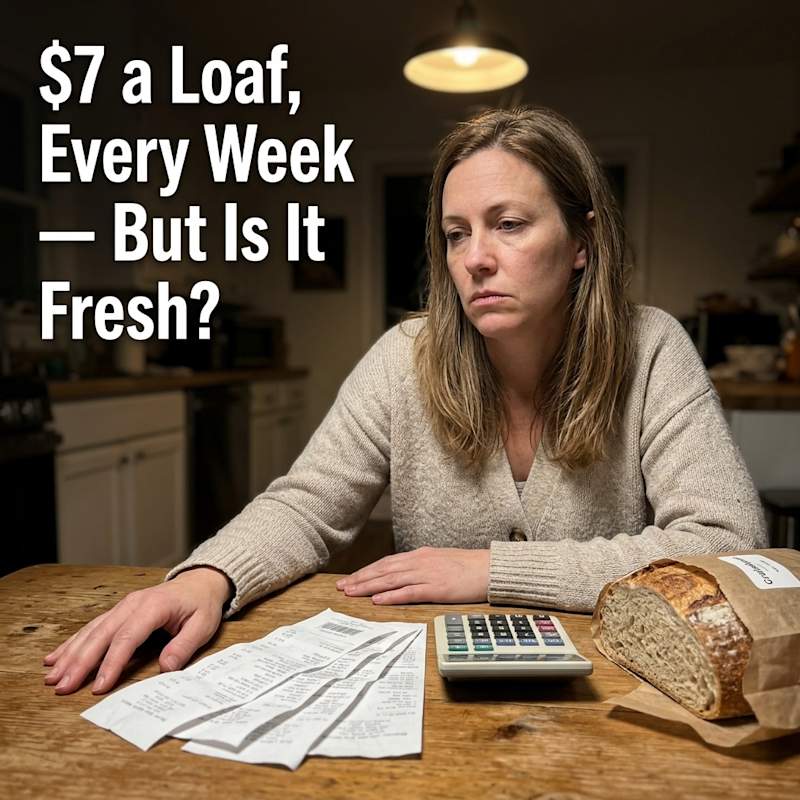

You're standing in the bread aisle again. The loaf in your hand says "organic," "whole grain," "stone-milled" — and it costs $7.49. You put it in the cart anyway, because what's the alternative? The $4 loaf that tastes like cardboard and lists twelve ingredients you can't pronounce?
Here's the question nobody in that aisle wants you to ask: how do you actually know that $7.49 loaf is fresh? "Organic" tells you how the wheat was farmed. It tells you nothing about how long ago it was milled, how much heat and oxidation the flour has already been through, or how many weeks it sat in a warehouse before it hit the shelf. You're paying a premium for a story, not a guarantee.

And it adds up. Three or four loaves a week, every week, for a year — that's real money, spent on bread you still can't verify. Home bakers on forums like The Fresh Loaf put it plainly: they call store flour "dead" long before they call it healthy. One baker described crying over how disconnected she'd become from something as basic as bread. That's not dramatic. That's what it feels like to realize you've been paying premium prices for a promise you can't check.
So you start looking into milling your own. Makes sense — control the grain, control the freshness. Except every mill you find is $300, $500, sometimes $900. And now you're stuck between two bad options: keep paying $7 a loaf indefinitely for bread you can't verify, or drop hundreds of dollars on a machine you might use twice and shelve. One Fresh Loaf user summed up the paralysis exactly: "I am racking my brains out trying to choose one… they are $1000!"
That's the real cost of this problem. It's not just the $7 loaves. It's the fact that the "better" option has been priced so far out of reach that most people never even test whether fresh milling is worth it for them. Before you spend another dollar in either direction, it's worth understanding why that gap exists — and whether it actually needs to.
Why What's Out There Falls Short

Here's what a little digging turns up, and it should change how you shop.
The organic bread aisle isn't selling you freshness — it's selling you certification. "Organic" is a farming standard, not a freshness clock. Refining and storage still take their toll: research from Harvard's Nutrition Source notes that refining strips more than half the B vitamins, roughly 90% of the vitamin E, and nearly all the fiber from wheat before it even becomes flour. None of that shows up on the label of a $7 loaf. You're paying for packaging, branding, and a certification stamp — not a promise that the flour inside is any fresher than the cheap stuff.
The premium mill market isn't built for someone still deciding. Machines from the well-known mill brands run $300 to $900, and they frequently backorder — so even a motivated researcher has to commit hundreds of dollars, sight unseen, before finding out if fresh milling fits their kitchen, their schedule, or their patience.
"I am racking my brains out trying to choose one… they are $1000!"— home baker, The Fresh Loaf forum
That's the quiet trap. One side of the market wants your money for a story about health. The other wants your money for a machine before you've tested the idea. Neither one actually answers the question you started with: what does fresh flour really cost, once you strip away the markup? That question has a real answer — and it's smaller than either side of that aisle wants you to think.
What Fresh Flour Actually Costs

Here's the reframe worth sitting with: the debate you've been having in your head — "which $400+ mill is worth it?" — is the wrong question. The right one is much simpler: what does the wheat itself actually cost, before packaging, branding, and distribution get added on? Wheat berries bought in bulk run about $0.80 a pound. Milled at home, the cost to grind a batch adds roughly $0.15. That puts a loaf of home-milled bread at approximately $0.95 — against $5 to $8 for a store-bought organic whole-grain loaf.
$0.95 vs. $5–$8 — the gap between what a loaf of fresh-milled bread costs to make, and what an organic loaf costs to buy.
Operator-verified per-loaf math, 2026Once you see that gap, the $300–$900 mill conversation looks different. The expensive machines aren't buying you better math — the math is the math regardless of which mill does the grinding. What they're really charging for is brand and hardware, not a better version of the number above. Which means the actual decision isn't "which premium mill do I trust" — it's "what's the lowest-risk way to find out if this math holds up in my own kitchen."
See the full per-loaf breakdown for yourself — See How It Works →
The Low-Risk Way To Test The Math

That's the gap Grainbloom was built to close. It's a countertop electric mill — one button, about 300 grams of fresh flour per batch, roughly 60 seconds — priced at $79.99. Not because the grinding mechanism is exotic, but because the price reflects what milling actually requires, without the premium-brand markup that inflates the $300–$900 tier. It's also currently in stock, while several premium mills are known to backorder.
Here's how it stacks up against the two options the market keeps pushing you toward:
Verify It Yourself, Before You Buy
Price the wheat berries
Price bulk wheat berries from a local mill or online source and run the per-pound math against your own grocery receipt.
Compare the entry cost
Compare the $79.99 entry price and in-stock status directly against the $300–$900 range and backorder timelines on premium mill sites.
Confirm the guarantee
Confirm the 30-day guarantee terms before you order, so you know exactly how long you have to test the math on your own counter, risk-free.
What Other Home Bakers Did Before Buying

If you're still deciding, you're in good company — and the smart move isn't to skip the research, it's to test cheap before you commit big. That's exactly the instinct one Fresh Loaf forum member described when weighing the same choice you're weighing now:
"Play with what I can easily buy and see if I even like it… AND THEN I'd go out and buy a Nutrimill."— home baker, The Fresh Loaf forum
Ready to run the numbers yourself? See How It Works →
Is $79.99 Too Cheap For A Good Grind?

The question that comes up most before buying: "If it's this cheap, what am I sacrificing — is the grind actually good enough?"
Fair question. The $79.99 price isn't a discount on the grind — it's what happens when you cut the premium-brand markup instead of the hardware. Every batch still mills roughly 300 grams of flour in about 60 seconds, one button, same as it would on a machine costing four times as much. The price difference is the brand tax, not the flour.
And you don't have to take that on faith either: the 30-day money-back guarantee gives you a full month to run your own per-loaf math, bake with the flour, and decide for yourself — before it's a final decision either way.