The Whole-Wheat Flour Trap: Why Even the "Good" Bag Is Already Half-Empty Before You Open It
For home bakers who've switched to whole-wheat flour, bought the expensive organic bag, and still can't shake the feeling that something's off — this is what the label isn't telling you.
There is a moment most serious home bakers describe the same way. They're standing at the counter, bag of whole-wheat flour in hand — the expensive one, maybe the one from the farmer's market brand, maybe the one that says "stone-ground" on a kraft-paper bag — and something nags. The bread is fine. But it's not that. The loaf is fine. But it tastes like something was left out.
Most of us assume it's our technique. Or the recipe. Or that we need a better oven. The bag is not where we look for the problem. This piece is about why the bag is exactly where the problem lives.
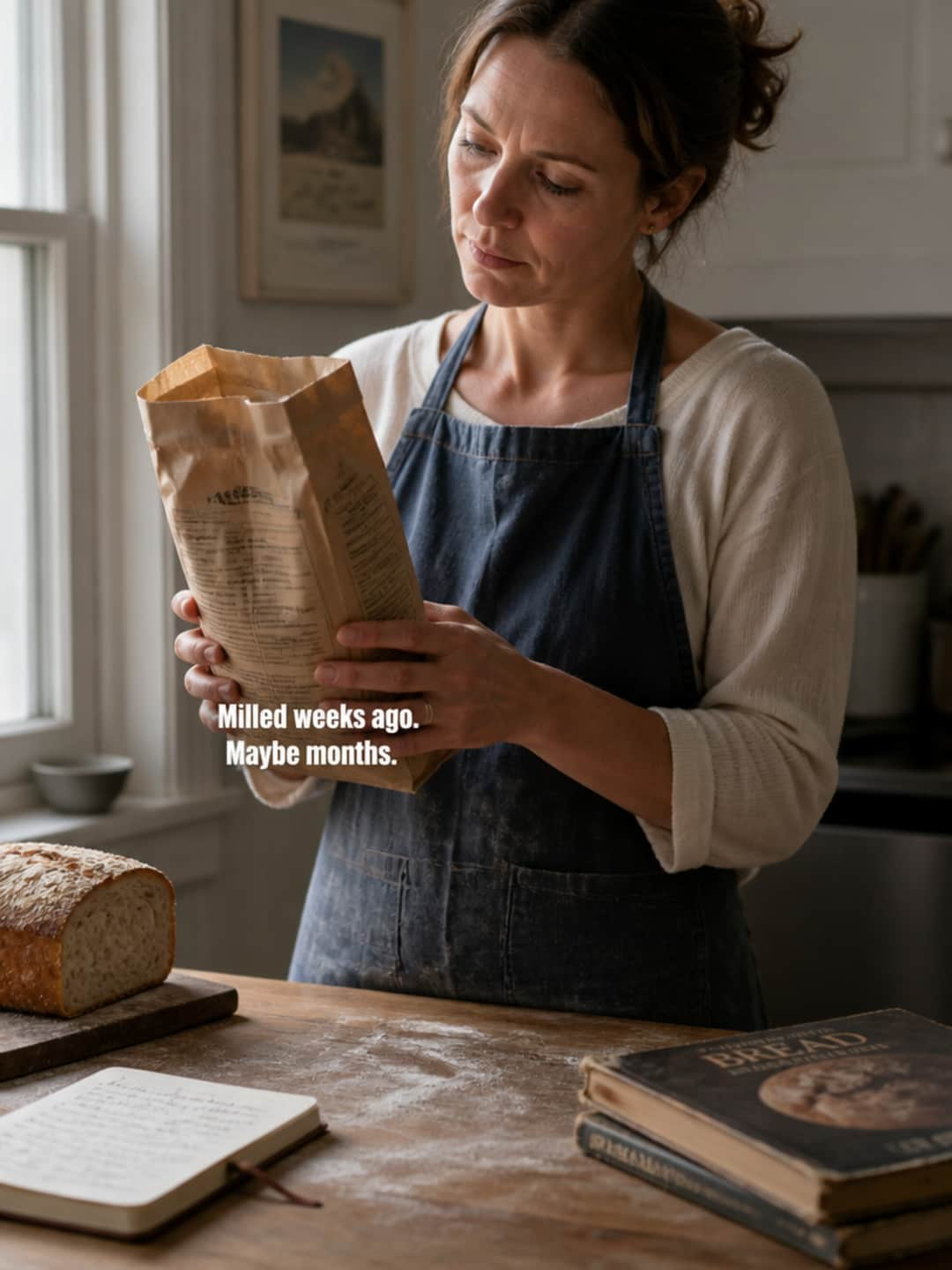
You started paying attention to flour labels because you started paying attention to what you were eating. That's not a small thing. Most people never get there. You did. You switched from the bleached white bag to the whole-wheat. Then maybe to the organic whole-wheat. Then maybe to the stone-ground. Each step felt like progress. And yet — and you might recognize this feeling — the bread still isn't quite what you imagined when you started caring about this. The loaves are a little dense. The flavor is a little flat. Not bad. Just not alive somehow. You've read enough now to know that fresh-milled flour is supposed to taste different. You've seen the photos, read the posts. You've told yourself it sounds like a lot of work, or an expensive hobby, or a rabbit hole you don't need. But the nag hasn't gone away.
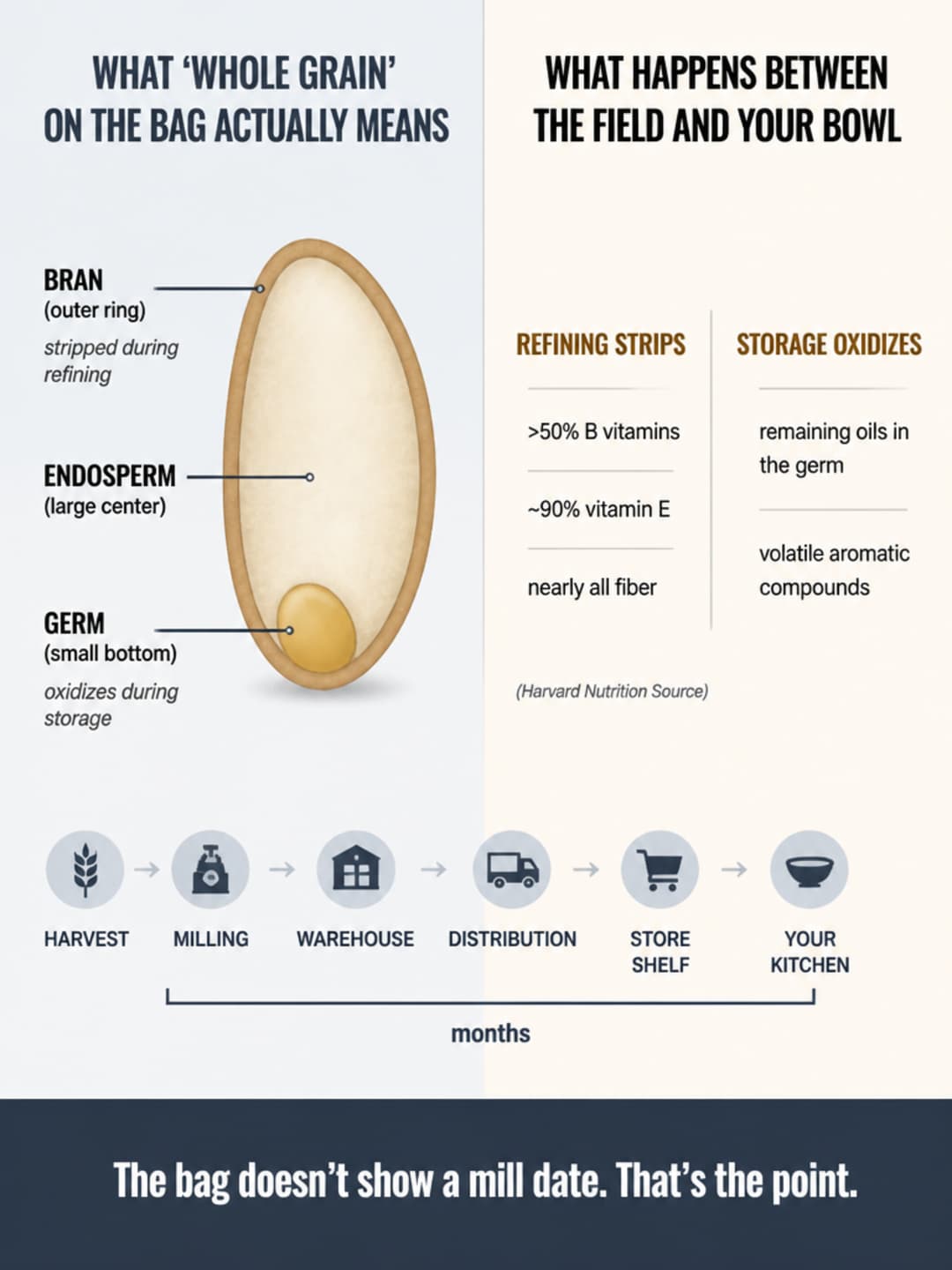
Here's what the nag is responding to. Whole-wheat flour — every bag of it, from every brand, at every price point — was milled somewhere between several weeks and many months before you opened it. From the moment grain is milled, the oils in the germ begin to oxidize. The volatile compounds that carry flavor begin to dissipate. The bag you're holding, whatever the label says about stone-grinding or ancient varieties or small-batch sourcing, is working against a clock that started running the day the grain was cracked open — and that clock has been running for a while.
That is not a failure of any particular brand. It is the unavoidable physics of milled grain stored in a bag. Nobody is hiding it. The industry just never built a reason to tell you about it, because until very recently, the alternative wasn't something a home baker could actually do. The "whole grain" label describes what went in. It doesn't describe what's still there when you open it. That's the thing the nag has been trying to tell you.
Why What's Out There Falls Short
Once you know to look for the milling problem, you start to see it everywhere. And you start to realize that the options most of us reach for — the premium bag, the organic bag, the whole-grain version of the standard brand — are not actually solutions to the problem. They are variations on the same architecture.
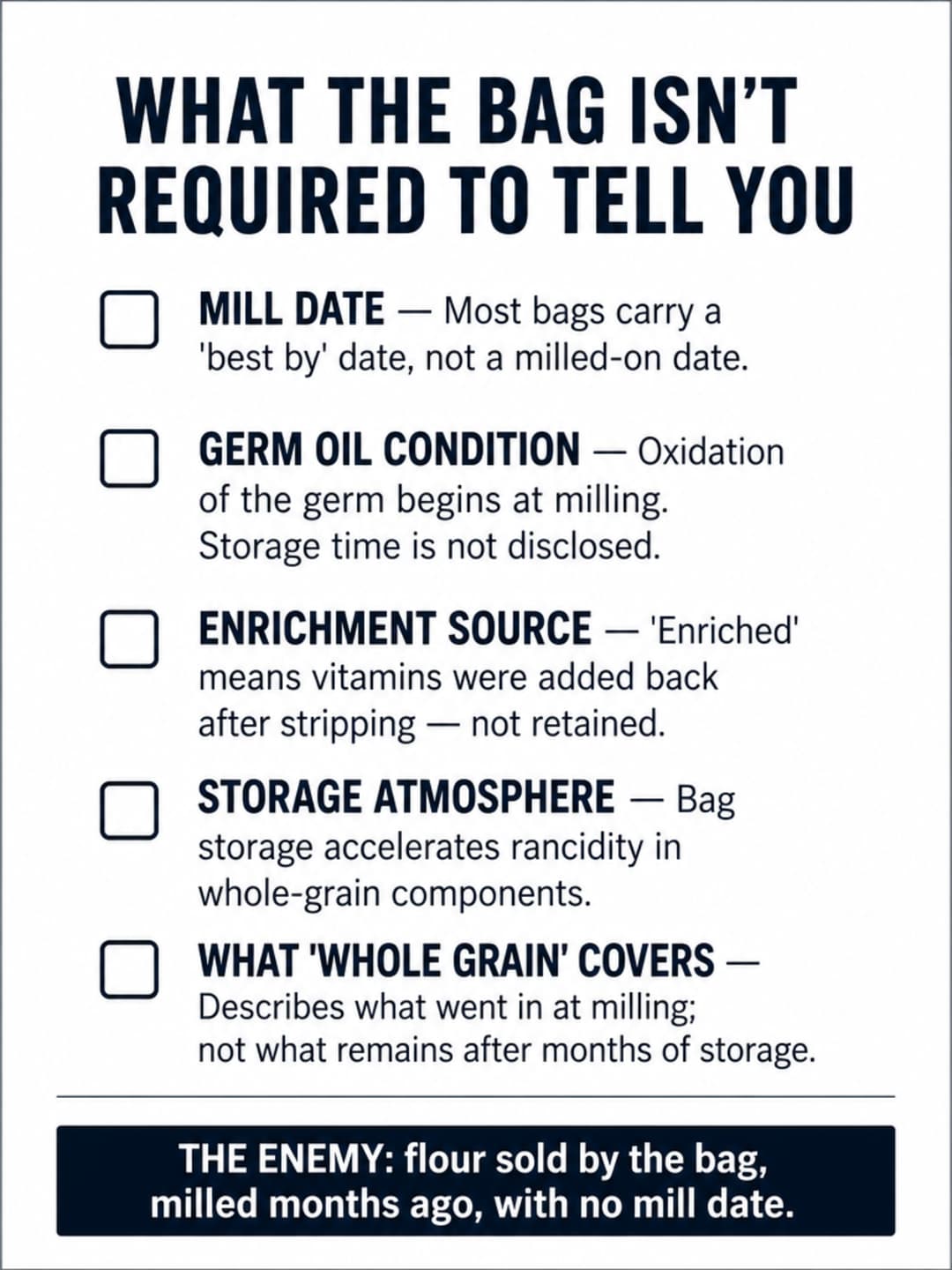
The enemy here is not a company or a brand. It's a model: flour milled at industrial scale, weeks or months before sale, stored in a sealed bag, and purchased without any indication of how long it's been sitting between its milling and your counter. That model is what every bag of flour — cheap or expensive, conventional or organic — is built on.
When you're evaluating flour options as a baker who cares about this, here's what to watch for. The bag describes what went in. It rarely describes when the grain was milled. "Stone-ground" describes the method; it doesn't describe the date. "100% whole wheat" describes the inclusion of bran and germ at time of milling; it doesn't tell you what condition those components are in after weeks on a warehouse pallet and more weeks on a store shelf. "Enriched" — which appears on most standard flour — is the industry's own admission that the original grain nutrients were largely removed and partially replaced with synthetic additions. That's not a fringe interpretation. That's what the word means.
I call fresh-milled flour 'alive' and store-bought 'dead' — and it's really true.
For a baker who has made the effort to seek out better flour, this is a particularly uncomfortable realization: the thing you've been upgrading within — the premium-bag category — has a ceiling that no brand can engineer around. The premium organic stone-ground bag is still a bag. The clock is still running. The question worth asking is not which bag is best. It's whether the bag model can deliver what you're actually after.
It's Not the Brand. It's the Clock.
Here is the thing that changes how you evaluate all of this. Most of the conversation about flour quality lands on what is in the flour — the nutrients, the grain variety, the milling method. That's a useful conversation but it misses the more fundamental question: how long ago was the grain opened?
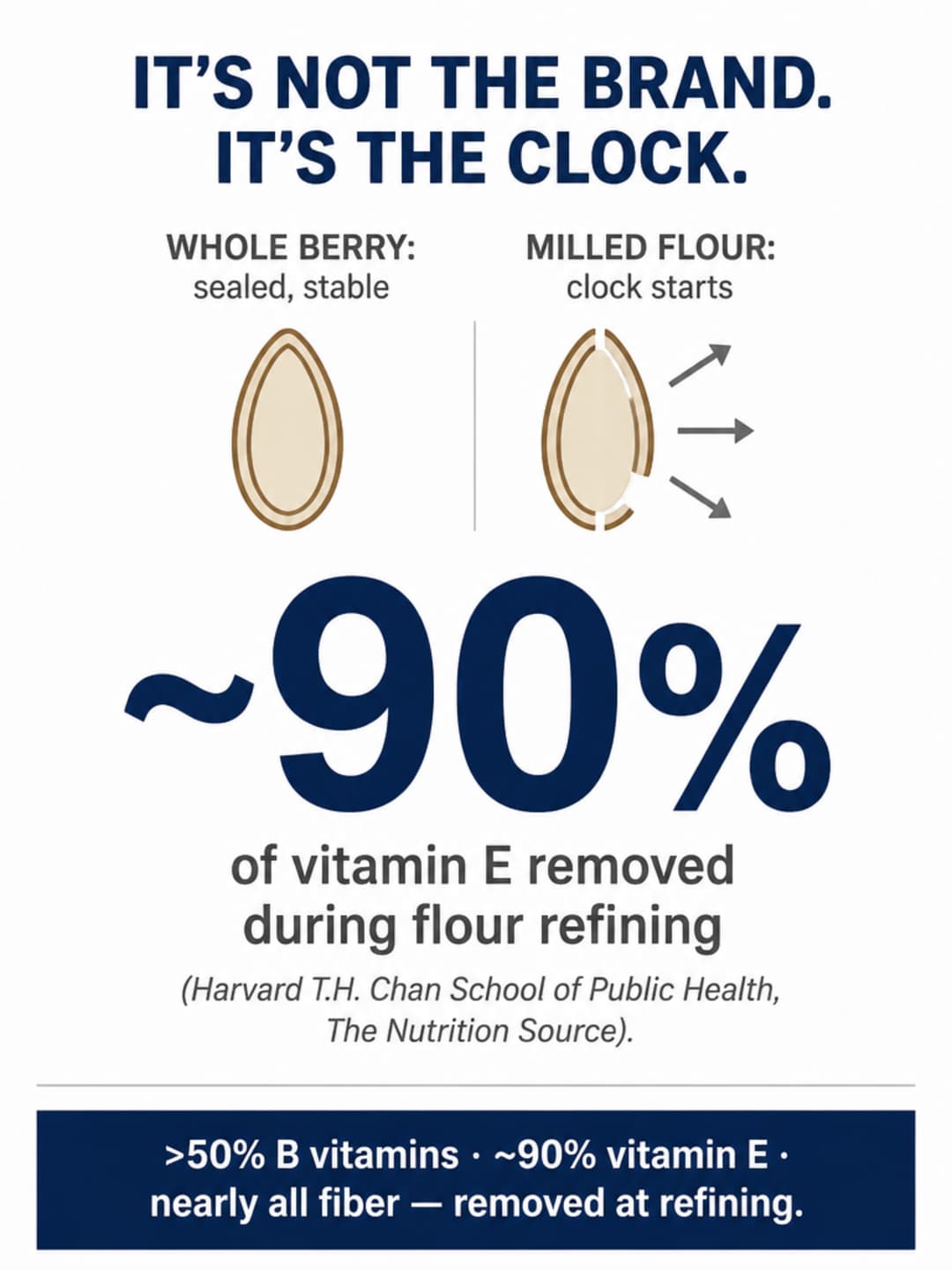
Grain in its whole, intact form is remarkably shelf-stable. The bran, germ, and endosperm are sealed together by the kernel's outer layer. The oils in the germ are protected. The volatile compounds that carry flavor are intact. This is why wheat berries stored properly can remain viable for years. The moment you mill grain — the moment you crack open the kernel — the clock starts. The germ's oils are exposed to oxygen. The aromatic compounds begin to leave. Refining the grain (removing the bran and germ entirely, as in white flour production) slows that clock by removing the most reactive components — but it also removes most of what made the grain worth eating. Research from the Harvard T.H. Chan School of Public Health documents what that stripping costs: refining removes more than half of B vitamins, roughly 90 percent of vitamin E, and nearly all of the fiber. "Enriched" formulations add back a fraction of those nutrients in synthetic form.
Whole-grain flour avoids the stripping problem but inherits the oxidation problem. The germ and bran are there — but they've been exposed since milling. The pattern that every evaluation of flour options should start from is not "which brand" or "which certification." It is: how much time has passed since this grain was milled?
That question, asked honestly, exposes the structural limit of every bag currently on the market — and it's the question the home milling conversation has been built around for decades. The gap between "whole grain" on a label and whole grain in your bowl is measured in months and in what gets stripped or oxidized during that time — not in brand quality or price point.
Harvard T.H. Chan School of Public Health, The Nutrition Source — refining removes >50% B vitamins, ~90% vitamin E, nearly all fiber.This is a different diagnosis from "buy fresher flour." It reframes the category itself as the structural problem, not any individual brand. No bag on the market — at any price — can solve a problem that begins the moment any grain is milled and continues through every week of storage between the mill and your counter.
Once you see the clock as the variable, the evaluation changes entirely. See what happens when the clock stops →
What Changes When the Clock Stops
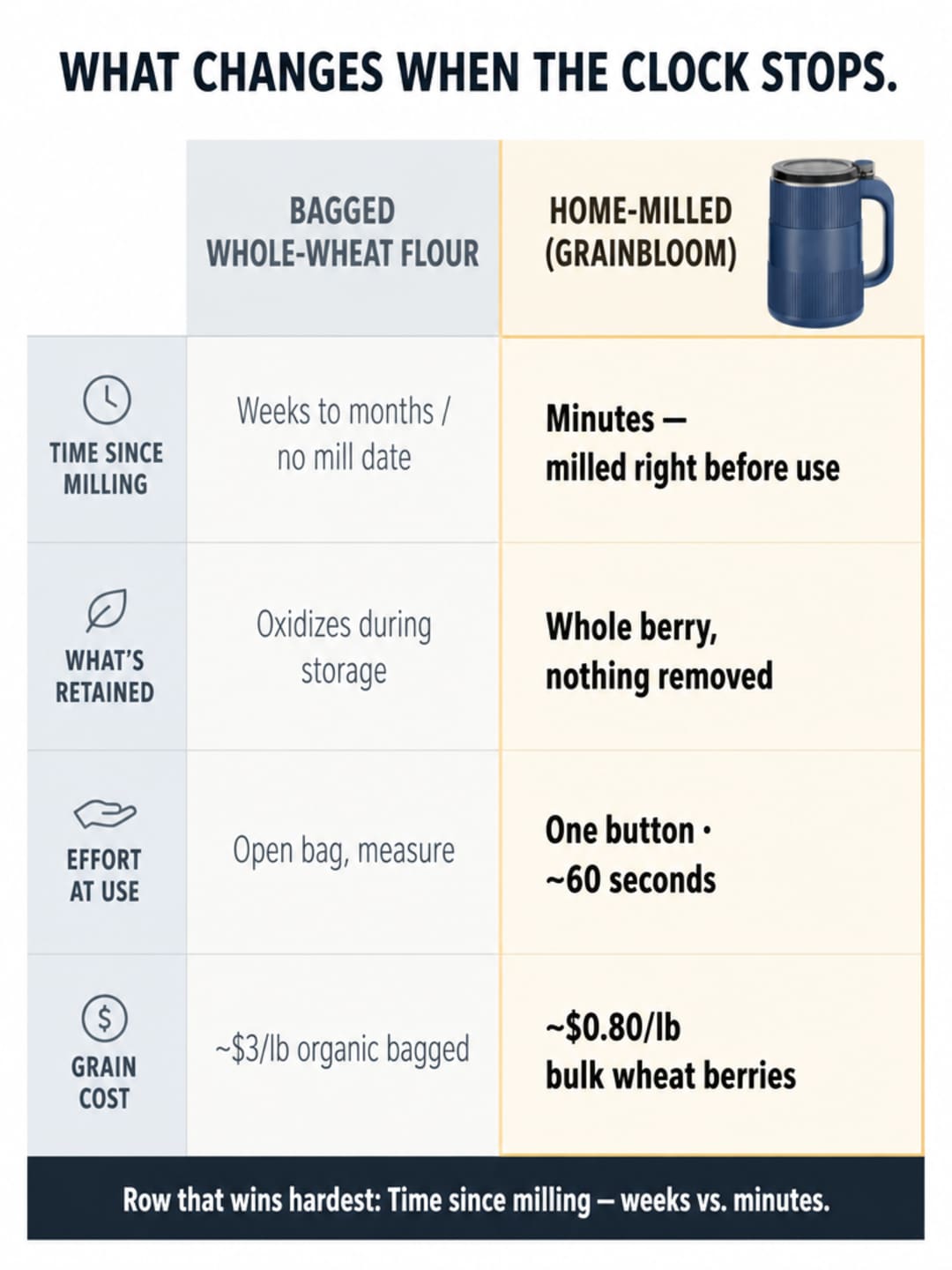
This is where home milling enters the conversation — not as a hobby or a lifestyle choice, but as a direct answer to a structural problem. A home grain mill takes whole, intact wheat berries — the same seed-stable form the grain has been in since harvest — and mills them immediately before use.
In the Grainbloom's case: you pour whole berries into the hopper, press one button, and in roughly 60 seconds you have 300 grams of flour that was part of an intact kernel five minutes ago. Nothing has been removed — the bran, germ, and endosperm mill together. The oils in the germ have had no time to oxidize. The aromatic volatile compounds are still present. The flour smells different from anything in a bag: sharp, slightly sweet, faintly grassy — the smell of something that is genuinely fresh. That smell is not incidental. It is the olfactory signal of oils that haven't turned. The mechanism is not complicated: it is time, reduced from months to minutes. That reduction is the whole thing.
Three Things You Can Check Before You Decide Anything
Find the Mill Date
Look for it on any bag of flour currently in your kitchen. The "best by" date is not a mill date. If you can't find when the grain was milled, that absence is itself information.
Read the Enrichment Panel
Read the ingredient panel on any "enriched" flour in your house. Note what was added back, and in what form. Cross-reference "enriched" with its regulatory definition: grain stripped of bran and germ, with a short list of synthetic nutrients added by legal requirement.
Check Harvard's Documentation
Read what the Harvard T.H. Chan School of Public Health's Nutrition Source documents about what refining removes — the figures are publicly available and specific. Then decide whether "whole grain, nothing removed, milled today" describes something meaningfully different from what's in the bag.
What the Community Reports — and Why the Pattern Is Consistent
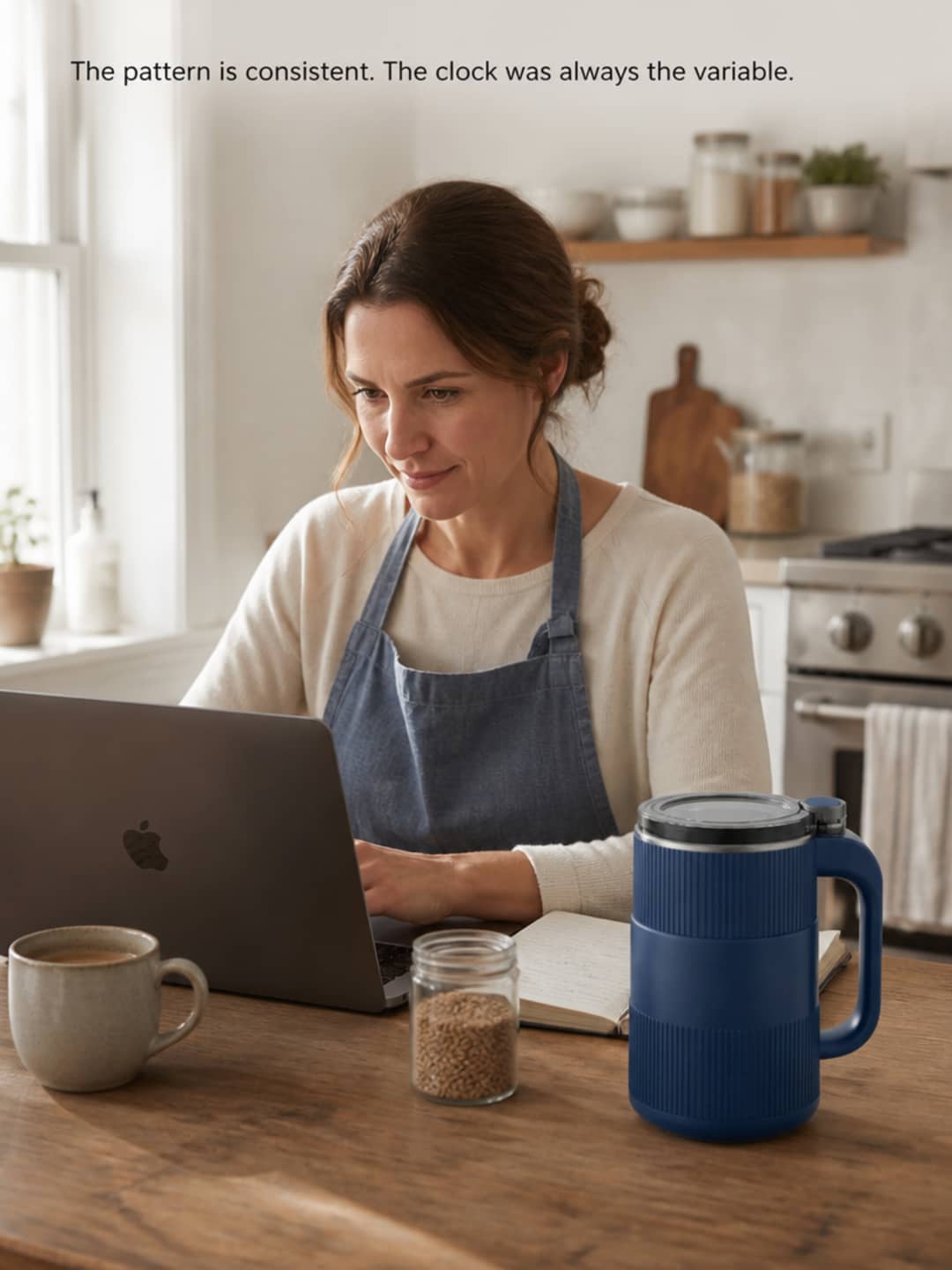
The community of home bakers who have made this shift is not small, and what they report is consistent enough to be worth paying attention to — not as testimonials, but as a pattern. The first thing most people mention is the smell. It's described as the thing that makes the gap real: you open the hopper and the flour that comes out smells like a bakery, or like rain on grain, or like something they hadn't smelled in a kitchen before. That's not marketing language — it's people describing, in their own words, the experience of volatile compounds that are still present rather than dissipated.
The second thing is the loaf. Specifically: the first loaf that works, after a period of frustrating attempts. Forum threads on fresh milling — the kind where bakers spend paragraphs comparing methods and failures — share a specific pattern. The early attempts are often dense. The technique for fresh-milled flour is different enough from bagged flour that a learning curve is real and documented. The people who work through it consistently describe the bread they arrive at as categorically different in flavor and texture from anything they made with a bag. The third thing — and this is the pattern that comes up in the people who are most skeptical when they start — is that once they've tasted their own flour, they describe the store bag as "dead" by comparison. That's the word that comes back, over and over, from bakers who were not predisposed to use it.
After months and years of dense, gummy loaves, I was feeling disappointed and deflated — literally.
You don't need to buy anything to verify the clock problem. Do the three checks above first. If they confirm what the nag has been telling you, the next page shows you the mechanism in full. See exactly what changes when the clock stops →
What If My First Loaves Are Dense and Flat?
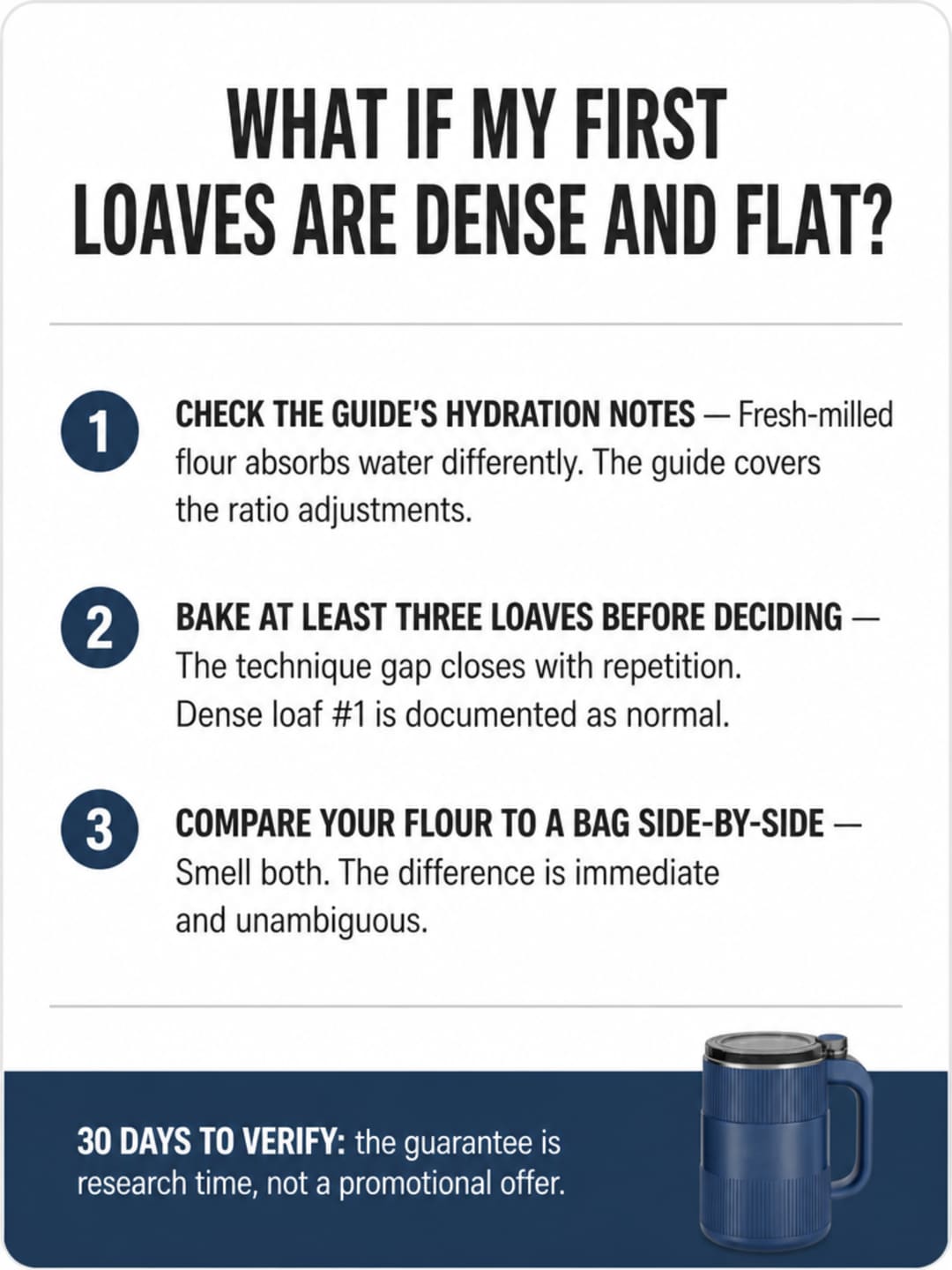
It is what happens, often, for the first few loaves. Fresh-milled flour absorbs water differently, behaves differently in a dough, and responds to fermentation differently from the bagged flour most of us learned to bake with. That is documented and real — it's not a problem with the flour, it's a technique gap.
The reason Grainbloom ships with the Fresh-Milled Baking Guide is precisely this: the dense first-loaf experience is the documented number-one reason people who try fresh milling quit. The guide covers the specific adjustments — hydration, fermentation timing, the handling differences — that turn the first few frustrating attempts into the bread you were trying to make. No other mill in this category bundles it.
And every Grainbloom comes with a 30-day money-back guarantee — not as a promotional flourish, but as actual time: enough time to mill several batches, bake several loaves with the guide, and verify for yourself whether fresh flour is what you suspected it would be. If it isn't, you haven't lost anything.