9.8
Our Score
⭐⭐⭐⭐⭐ Editor's Pick
7 Reasons the FreshGrain Mill Beats Every Flour Bag (and Every $300 Mill) You've Tried
Every grain mill under $100 got called a toy. Every mill over $300 went on backorder. FreshGrain Mill ships now at $79.99 — mills 1 lb of fresh flour per minute — and pays for itself in about 12 loaves.

Quick Summary
Store-bought organic flour loses 50%+ of its B vitamins and ~90% of its vitamin E in industrial milling — and costs $5–$8 per loaf. The FreshGrain Mill produces fresh flour in 60 seconds at roughly $0.95 per loaf, ships at $79.99, and includes a beginner's baking guide so your first loaves actually rise. If you've been stuck between a $400 risk and a cheap grinder you don't trust, this is the exit.
You've already done the research. You know dead flour is a real problem. You've probably tried at least one solution that disappointed you — a KitchenAid attachment that choked on hard wheat, a cheap grinder that left gritty flour, or a premium mill that shipped six weeks late (or not at all). This review exists for one reason: to show you exactly how FreshGrain Mill compares to everything else you've considered — on specifics, not promises.
What Changes for You
1
Every "affordable" grain mill you've seen promised fresh flour. Most delivered gritty dust — or a backorder confirmation.
Every sub-$100 grain mill on the market carries the same reputation problem: the fresh-milling community calls them toys. "All the mills costing less than $400 were more like toys," reads one of the most-cited reviews in home-milling circles. That reputation exists because most cheap mills use plastic burrs, struggle with hard wheat berries, and produce inconsistent grind fineness.
FreshGrain Mill is built differently — 304 stainless steel contact surfaces, one-button operation, and a fineness profile designed for actual bread baking, not smoothie flour. It mills 1 lb of flour per minute. It doesn't burn out your KitchenAid. And at $79.99, it doesn't ask you to bet $300+ on a category you're still learning.
The first question isn't "which mill." It's "which mill won't end up in a cabinet." That answer lives in whether the result — the flour — actually makes bread your family eats.

2
The nutrition gap between store flour and fresh-milled flour is not subtle. It's federally documented.
Industrial milling removes more than 50% of B vitamins, approximately 90% of vitamin E, and nearly all of the fiber from wheat. What you get back is a partial synthetic replacement mandated by federal law — the "enriched" label on every bag. This isn't a wellness claim. It's documented by Harvard T.H. Chan School of Public Health and codified in 21 CFR 137.165.
Fresh-milled flour — wheat berries ground minutes before baking — retains the full bran, germ, and endosperm. No synthetic patch. No warehouse storage. No nutrition math that works against you.
When you mill your own flour, you're not upgrading. You're stopping a subtraction that's been happening every time you've bought a bag.
50%+B vitamins lost in store flour
3
The flat-loaf problem is real — and it's why most people quit before they start.
"I almost gave up! Breads that didn't rise and hard, flat cookies." That's not an outlier. It's the most common failure point in fresh-milled baking — and it's not a skill problem. It's a process problem. Fresh-milled flour behaves differently than store flour. Hydration ratios shift. Fermentation timing changes. Without knowing this going in, your first few loaves are almost certainly going to be wrong.
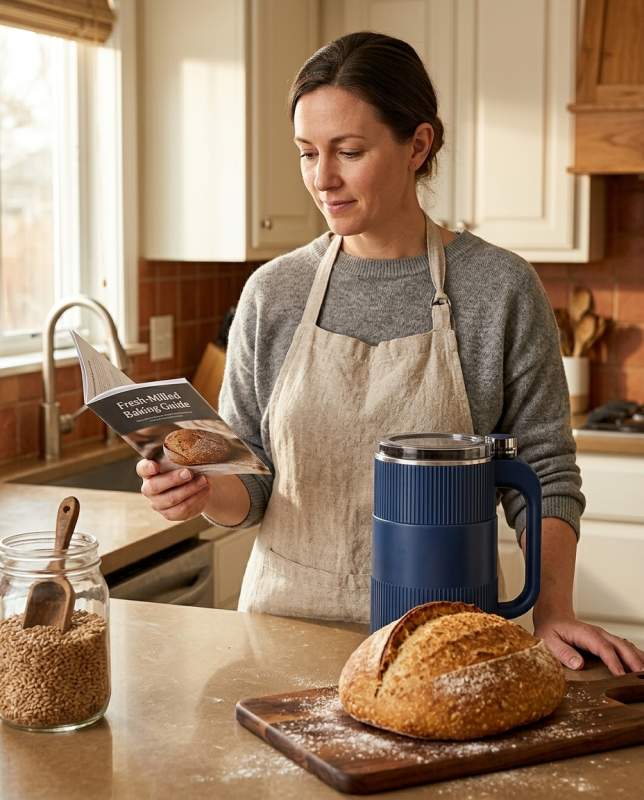
FreshGrain Mill is the only entry-level mill that ships with a Fresh-Milled Baking Guide specifically written for this transition. Not a generic bread cookbook. A guide built around the adjustments fresh-milled flour actually requires.
This is the only reason the learning curve exists — and it's the only thing that makes the guide genuinely different from what's free on YouTube.
Why It Works
4
One button. Sixty seconds. No flour-bag run.
The operational case for home milling collapses if it takes longer than the alternative. FreshGrain Mill mills 1 lb of fresh flour in approximately 60 seconds. Single button. No burr adjustment learning curve. No cleanup ritual that costs you 20 minutes.
Wheat berries store for years in a sealed container. You buy them once in bulk at $0.60–$1.50/lb. You mill what you need, when you need it. No flour going stale in the back of a cabinet. No emergency grocery run because you forgot to check the bag.
The mill that actually gets used is the one that fits into real cooking — not the one that requires a dedicated workflow.

5
It doesn't touch your KitchenAid.
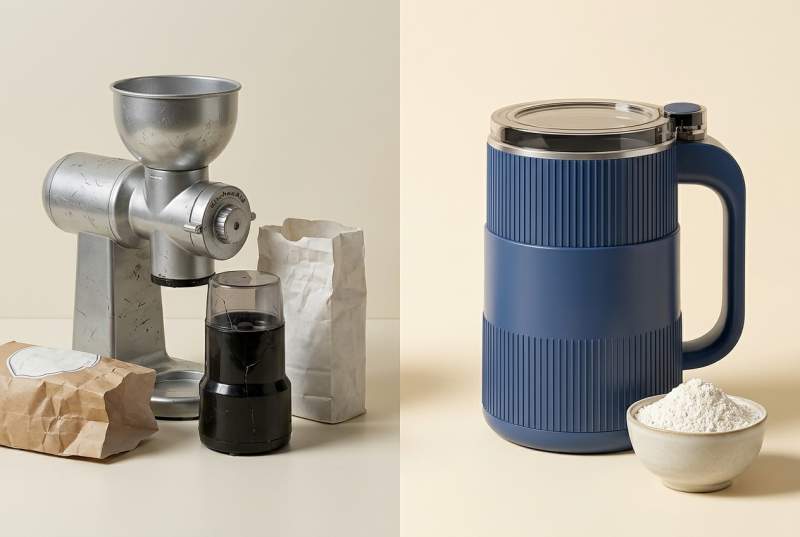
KitchenAid grain mill attachments have a documented failure pattern in the fresh-milling community: they struggle with hard wheat berries, they run hot, and they risk damaging a $400+ stand mixer. The attachment was designed for light-duty use. Hard red winter wheat is not light duty.
FreshGrain Mill is a dedicated appliance — meaning your mixer stays exactly what it's built for, and your milling has a purpose-built motor behind it. No shared stress. No warranty grey areas on your KitchenAid.
Protecting a $400 mixer while gaining a fresh-flour workflow is not a trade-off. It's a net addition.
$400+mixer protected from hard-wheat stress
6
304 stainless steel. No plastic in the flour path.
Most sub-$100 mills use plastic or ceramic-coated burrs. The flour contacts plastic. Under heat from repeated milling, plastic surfaces degrade. The FreshGrain Mill uses 304 stainless steel contact surfaces throughout the flour path — the same grade used in food-grade kitchen equipment.
This matters for two reasons: flavor integrity (no plastic transfer into your flour) and durability (stainless resists degradation from the abrasion of hard grain). It's the hardware difference that separates a mill you use for years from a mill you replace.
At $79.99, 304 stainless steel contact surfaces are not standard. On FreshGrain Mill, they are.
304stainless steel flour path — no plastic contact

Why Now
7
You've already spent more than $79.99 on the problem this solves.
Add it up: organic whole-grain flour at $6–$9/bag. Two bags a month. A KitchenAid grain attachment you tried once. Maybe a cheap mill that produced gritty results. That accumulated spend is likely already past $79.99 — and none of it solved the problem.
The math on FreshGrain Mill:
Store organic whole-grain loaf: $5–$8
Home-milled loaf from wheat berries: ~$0.95
Savings per loaf: up to ~$7
Mill cost: $79.99
Loaves to break even: approximately 12
After loaf 12, the economics permanently shift. Every loaf you bake past that point costs you roughly $0.95 instead of $5–$8. Two loaves a week for a year = over 100 loaves. The math does not get complicated.
The 30-day guarantee means you can bake your first 12 loaves risk-free and confirm the math yourself before it costs you anything.

FreshGrain Mill vs. Every Alternative You've Considered
Feature
Other Options
FreshGrain Mill ★ Winner
Price
$300–$900 (premium) · $30–$75 (cheap) · $69–$150 (attachment) · $6–$9/bag ongoing (store flour)
$79.99 — one time
Ships Now
Premium mills often backordered; store flour always available
✅ Yes — no backorder, no wait
Nutrition Integrity
Store flour: 50%+ B vitamins lost, ~90% vitamin E lost · Cheap grinders: heat risk / inconsistent · KitchenAid: heat risk on hard wheat
✅ Full bran, germ & endosperm retained
Per-Loaf Cost
Store organic: $5–$8 · Cheap grinder: ~$1.10–$1.50 (grit loss) · KitchenAid attachment: ~$1.00–$1.50
~$0.95 per loaf
Beginner's Guide Included
❌ None of the alternatives include one
✅ Fresh-Milled Baking Guide included
Flour Path Material
Cheap mills: typically plastic or ceramic · KitchenAid attachment: aluminum/plastic · Premium mills: stainless (at 4–11× the price)
✅ 304 stainless steel — no plastic contact
Protects Your KitchenAid
❌ KitchenAid attachment shares mixer stress and risks motor damage
✅ Dedicated motor — mixer untouched
The comparison is clear. The only question is whether you want to test it.
Try It Risk-Free →
~$7
saved per loaf vs. store organic
~12
loaves to full payback
60 sec
per pound of fresh flour
50%+
B vitamins retained vs. store flour
⭐⭐⭐⭐⭐
"Alive flour" vs. "dead flour" — and it's really true.
"I now call fresh-milled flour 'alive' and store-bought flour 'dead.' And it's really true."
🌾 Switched from store-bought flour
TA
Twisted Ash Farm
Home Baker
⭐⭐⭐⭐⭐
"I almost gave up" — until the process finally clicked.
"I almost gave up! Breads that didn't rise and hard, flat cookies. I finally figured out what I was doing wrong — but I wish I'd had a guide from the start."
📖 Now uses the Fresh-Milled Baking Guide
CL
Country Living Customer
Home Baker
⭐⭐⭐⭐⭐
"This mill saved my life."
"There were times I had no money for food. My friend and this mill saved my life."
🛡️
30-Day Money-Back Guarantee
Mill your first dozen loaves. Compare the cost. Compare the taste. If FreshGrain Mill hasn't changed your relationship with flour by day 30, return it for a full refund. No explanation required. Free shipping both ways.
You're not buying a mill. You're testing a math equation — risk-free.
Is FreshGrain Mill Right For You?
Perfect for you if
- You're already buying organic whole-grain bread or flour and tired of the price
- You tried a KitchenAid attachment or cheap grinder and it disappointed you
- You can't justify spending $300–$900 before knowing if fresh-milling sticks
- Your bread attempts keep producing flat, dense loaves — you need a process fix, not just a better recipe
Not for you if
- You bake fewer than once or twice a month — the per-loaf math won't reach payback meaningfully fast
- You need commercial-volume output across consecutive large batches — this is a home-kitchen appliance
- You want plug-and-play results with zero learning curve — the guide helps, but fresh-milled baking still requires some adjustment time
Our Verdict
9.8/ 10
FreshGrain Mill is the only sub-$100 mill that credibly closes the gap between "toy grinder" and "premium backordered machine" — with stainless steel hardware, a bundled beginner's guide, and per-loaf economics that pay back in about 12 loaves. If you're done buying dead flour and done waiting on a $400 mill you're not sure you'll use, this is the decision.
🏆 Editor's Pick
FreshGrain Mill
⭐⭐⭐⭐⭐

Today's Price
$79.99$299
✅ 304 stainless steel flour path · ✅ Mills 1 lb fresh flour per minute · ✅ Fresh-Milled Baking Guide included · ✅ Free shipping · ✅ 30-day money-back guarantee
Ships now — no backorder, no wait
🔒 Secure checkout↩ 30-day full refund🚚 Free shipping🌾 Harvard-verified nutrition data
Still Not Sure?
Is $79.99 really enough for a mill that doesn't feel like a toy?
The "toy mill" reputation comes from plastic burrs and underpowered motors. FreshGrain Mill uses 304 stainless steel contact surfaces and a dedicated motor — not a mixer attachment. The hardware is built for hard wheat berries. The community criticism of cheap mills is about construction quality, not price alone.
How does the $0.95 per-loaf figure work?
It's based on wheat berries at roughly $0.80/lb plus a conservative amortization of the mill cost across its use. The comparison is specifically against organic whole-grain store bread at $5–$8 per loaf. If you're currently buying conventional $2–$3 bread, the economics are narrower — this comparison is scoped to organic whole-grain.
What does the Fresh-Milled Baking Guide actually cover?
It addresses the specific process differences between store flour and fresh-milled flour — hydration adjustments, fermentation timing, and the density/flatness issues that cause most beginners to quit. It's not a general bread cookbook. It's built around the transition from store flour to fresh-milled.
What if it doesn't work out?
30-day full money-back guarantee. Return it within 30 days for any reason. You have enough loaves to confirm the math before the guarantee window closes — no questions asked, free return shipping.
This advertorial reflects the editorial opinion of the reviewer based on product specifications, publicly documented research, and verified customer accounts. Nutrition data sourced from Harvard T.H. Chan School of Public Health and 21 CFR 137.165. Per-loaf cost estimates based on wheat berry pricing of $0.60–$1.50/lb compared to organic whole-grain store bread at $5–$8 per loaf; individual results vary based on baking frequency and ingredient sourcing. The $299 reference price reflects the anchor pricing displayed on the product page. Payback estimate of approximately 12 loaves assumes up to $7 savings per loaf vs. organic store bread. Results are not guaranteed. This content is not medical advice. No medical claims are made or implied.